Categories
Current Projects Integration into Community

How can social service providers get people to legal help?

During my Spring 2015 class at Stanford d.school/Law School on Intro to Legal Design, we were lucky enough to have Sacha Steinberger visit us and present on her Project Legal Link. I drew up some notes during her presentation, about what she’s working to do — bringing social service providers into the world of legal services.

Here are my sketches:

imageimage

image

Even if a social service case worker spots legal issues in their client’s situation, they often don’t know how to effectively reach out to get legal help for the client.

image

Sacha has identified the social service caseworker as a key ‘legal portal’ — someone who can help get lay people to legal services that they need, and start them on the journey to resolving their problems around housing, debt, relationships, employment, custody, and other common problems that people have and don’t know there is legal recourse for.

image

So what does Project Legal Link do, to help improve social services’ capacity to serve as an effective legal portal?image


image

image

The ideal new workflow would be that social service providers would be this portal, and would do the following:

image

Sacha’s approach is to make it easy for social service providers to know what to do when spotting legal issues and referring for legal help — and empower them to serve their client in fuller ways.

image

image

With smarter caseworkers, then the client will get a fuller team of people to help them.

image

Categories
Current Projects Hearings

Youth courts, for kids & run by kids

On Friday July 24th, 2015 the Bay Area NPR-affiliate, KQED, reported on a local juvenile court that takes a unique user-oriented approach to justice.

Matthew Green’s report Inside Oakland’s Youth Court, Where Kids Call the Shots describes the Centerforce Youth Court, that takes on offenders who are juveniles with first-time misdemeanors. Most everyone working in the court are also juveniles — including the jurors judging the offender, the attorneys prosecuting and defending her, and the bailiffs and clerks ensuring the court operates correctly. The only non-juvenile is the judge.

The overarching goal of the program is to reduce recidivism, promote restorative justice, and reduce the mainstream court’s caseloads by redirecting these types of juvenile cases to this special design — which promote more community involvement and workshops.

This style of youth court exists throughout the US, with more than 1000 nationwide and some 120 in California.

What would other radically redesigned court systems look like — particularly ones that take the peer-to-peer model to heart? Could other specific types of cases be siphoned off the mainstream criminal/civil systems into courtrooms & organizations designed to be more community-oriented, rehabilitative, and understanding from the lay-person’s perspective?

On a recent evening, kids waited nervously in the hallway for their trials to begin. The court serves about 120 offenders each year, usually referred by police or school officials. To participate, offenders have to first confess to their crimes.

The docket was full that night – cases ranging from vandalism and minor drug possession to theft — as in the case of one shy young lady named Preva, who stole some makeup before a piano recital.

“Preva wanted this night to be perfect, every little thing, so she went to a store and stole some makeup,” Gabrielle Battle, a petite 13-year-old serving as Preva’s attorney, tells the jury.

“She was blinded by the idea of perfection and looking perfect for her big night.  … I will prove to you, the jury, that Preva was just a young kid making a mistake, and she is sorry for what she did.”

Following opening statements, the jurors ask the defendant questions and then  deliberate. Decisions are legally binding: If defendants complete the sentences, their records are closed, as if the crime never happened.

“At the end of the day, their record is closed to the public,” explains Angela Adams, the court’s program coordinator. “On some job applications, there’s a form  where they check off the box, ‘Have you ever committed a crime?’ and they’re able to check the box that says ‘no.’ ”

….

“When you come here, you actually get to, like, go to workshops, do community service, do things that can actually give back to the community,” says Akili Moree, another feisty 13-year-old who joined the program voluntarily last year and works the courtroom like a mini Perry Mason. “And you can learn from your mistakes, instead of just receiving a punishment that you’ll really get nothing out of.”

For Michaela Wright, things ended much better than she expected. The jury gave her 12 hours of community service, three workshops and two jury duties. She plans to start college this fall, with a clean record.

Wright says she appreciates that the process wasn’t just focused on punishment, and wishes she could say the same for her parents, who were none too pleased about her arrest.

When asked if she got in trouble at home after her arrest, she simply replied:

“Oh, yeah … oh, yeah.”

Read the full story here at KQED’s site.


Categories
Current Projects

Designing a Usable Online Privacy tool

I am working with a team at Carnegie Mellon to create more Usable Privacy Policies. One of the main deliverables we’re creating is a plugin for web browsers, that shows the user information about the site that they’re on. The goal is to present information about the site’s legal and privacy policies in compelling ways, so the person visiting the site will be a more critical consumer of it.

The plugin would be an intervention just-in-time, as the user has arrived on a site & is assessing whether she wants to stay there, explore it some more, or give it her usage data if not also subscription. How do we help her be smart about whether she wants to use that site & accept its privacy practices?

Privacy Policy design  user journey

Back in May, I worked with one other leader of this project, Pedro Leon who is a fellow at Stanford Law School’s Center on Internet & Society, did a design sprint to create sketchy mock-ups of what some different browser plugins might look like. Our goal was to create paper mock-ups of possible browser interfaces, that we could do some quick testing with on that day, and then refine them into proper digital mockups to test in focus groups and online.

Usable Privacy policy - workshop work

We tried to capture a range of different messages, compositions, moods, and hierarchies. For our first round of designs, our concepts ranged from the hyper-complex to the hyper-simple. Our main line of variables was along how much information we presented.

User Interface for Privacy Policy spectrum - variables from super clean to hyper detailed

We also were cognizant of possible variations in elements & composition that we could use in putting together possible plugins.

User Privacy Plugin design variables

And we also drew on some other inspiration & analogies for how we could present information like privacy ratings.

Usable Privacy Policies - plugin inspiration - Screen Shot 2015-05-11 at 6.03.43 PM Usable Privacy Policies - plugin inspiration - Screen Shot 2015-05-11 at 6.02.56 PM Usable Privacy Policies - plugin inspiration - Screen Shot 2015-05-11 at 6.02.46 PM Energy Label rating display

Mock-ups of possible privacy plug-in interfaces

Along the axis of simple to complex information, we created some very raw sketches of what a plug-in interface could look like.

Here’s the most simple: a single grade and some links to see what this grade actually looks like:

Usable Privacy Policy design project - IMG_20150512_143251.767

We didn’t necessarily think this super-simple grade would actually be the most effective or user-friendly interface, but our goal was to stretch our own imagination about what’s possible and divine the right amount of simplicity-information balance.

A slightly more complex interface (but still on the simple end of the spectrum) is a letter-score plus some more, very simplified markers of a score — emoji faces, a text description, or something that gives a very glanceable impression of ‘is this good or is this bad?’

Privacy Policy Design scoring

From these very stripped down designs, we started to get to more plausible, and richer designs — though we still tried to keep the amount of information to a relatively simple & digestible quantity. Here are some slightly more complex interface sketches.

This design is the Letter-Score plus 3 possible actions for the user to take in response:

Usable Privacy Policy design project - IMG_20150512_143309.943

The thought was to give a simple rating/assessment, combined with user choice to make it more actionable and empowering. We created a few more slightly complex variations of this theme: rating plus user choice.

Here is one design, with a Rating plus many User Choices — the emphasis is on a quick alert about the rating of the site, and then following up with a large menu of possible responses that the user is able to take in order to protect herself and send her preferences to the site and wider community.

Usable Privacy Policy design project - IMG_20150512_124718.470

We also created a collection of interfaces that give some more detail to the rating, pairing an overall score with a breakdown of sub-category scores.

Here is one Rating – Sub-rating – Action design:

Usable Privacy Policy design project - IMG_20150512_124633.135

And another Rating – Sub-rating – Action design, this time with sub-ratings on a scale (potentially with other competitor sites also featured on the scale to show comparisons):

Usable Privacy Policy design project - IMG_20150512_124621.241

And one last Rating – Sub-rating – Action design, this time also with a ‘comparison’ option woven in, to allow the user to shop around for other options besides the page they’re currently on:

Usable Privacy Policy design project - IMG_20150512_124702.590

Here’s a design with the same information pattern Rating – Sub-rating – User Action, but with more visual elements. We took a card & icon based approach, to use less text and more graphics to show off the info.

Usable Privacy Policy design project - IMG_20150512_124646.125

And one other design was focused totally on User Choices, giving a whole visual menu of actions to make the user feel empowered & activated.

Usable Privacy Policy design project - IMG_20150512_124609.926


And a final sketch was to have all kinds of information — rating, sub-rating and explanation, choices, and participation invitation — but to have it selectively displayed through sliding displays where the complexity is only shown upon click or hover by the user.

IMG_20150508_201106.638

Testing Results

So what did our initial, quick testing of these interfaces tell us? Our main message actually upended much of our design hypothesizing. The key factor in the user response was not the amount/complexity of information, but rather the tone, mood, and framing of the message. Though users did show some interest in the amount of detail when assessing how trustworthy & useful the plugin was — the real factor in whether they would use it or not was ‘is this plugin neutral, reliable, and apolitical?’

The user testers were aware enough of privacy and the importance of it, but they did not want any kind of presentation that seemed too radically pro-privacy or anti-tracking. They do not want the sense that the makers of the plugin have a strong agenda as to what is good or bad when it comes to how companies gather data about their users. Rather, they want ratings and recommendations that seem to be neutral, apolitical, and based on clear & authoritative standards.

The language that we had used in our quick sketches alienated the user testers, because it seemed to be too bossy, strident, and like an advocacy group.

Instead, the users said they’d rather something like Film Ratings (G, PG, PG-13, R) that seem to be quite objective and without explicit messages that say whether things rated this way are good or bad. Rather, the people who have rated films seem to just be putting out the neutral rating out to the public without telling the public how they should they react or whether the film is good or bad.

They also suggested that we follow the model of Commonsense Media, an organization that rates movies, tv, games, and other media as to whether it’s family-friendly and kid-appropriate or not. According to one tester, Commonsense does an excellent job at making its ratings persuasive because they do it with a strong veneer of neutrality. They do not use highly-charged language, they do not condemn or use political messaging, and they leave it up to the parents to read the ratings and decide what their response should be.

The main lesson learned from the testing is the importance of language, framing, and messaging. Complexity to simplicity of information presented is important, but even before that, we must care about how we present the tone of information. We must aspire to neutrality & authority by avoiding words like ‘threat’ and ‘risk’, and not calling for too much advocacy or political change. We must show the user respect, by encouraging them to decide what they want to do with our ratings. And we must clearly show that our ratings are based on objective and reliable standards, and not arbitrary or politically-charged.

The second lesson is to frame the plugin as something that saves the user time, giving them the luxury of a shorthand & easy version of something that they want to know but don’t want to spend time on. The users want a Cliff Notes version of privacy information. The value proposition that would get the user to download the plug-in in the first place (and then not delete it later) – is “We (smart lawyers or the like) have read it so you don’t have to!” or “You care about privacy but you don’t have time to figure it all out — let us help you do it quickly, cleanly, and in an empowering way”

Here are my notes, taken during the testing session.

IMG_20150512_142808.630 IMG_20150512_142825.400 IMG_20150512_142752.450 IMG_20150512_142739.594 IMG_20150512_142837.383

Design Notes

As an addendum for the design process-geeks out there, here is some documentation of how we ended up at our designs & how we are moving forward. Before we actually took pen to paper to make our rough mock-ups, we had gone through what the essential content, elements, and user/system requirements would be for our plug-in design. These were constraints and options we could play with.

User Privacy Policy plugin design requirements and notes

Here are some of the questions that we have to grapple with as we craft our designs, message, and experience:

Questions for Privacy Policy design

We fleshed out user requirements for what the plug-in should provide functionally, as well as what impression and experience it should create with the users.

Privacy Policy Plugin Goals for design

And here are the types of content that we can be displaying in the plug-in (though we can prioritize and hide some of these):

Privacy Policy content

Finally, here are notes on the next battery of testing we’ll run in focus groups:

Usable Privacy Project focus group notes

Stay tuned for more updates — more beautiful & refined interfaces — and testing results from these focus groups!


Categories
Current Projects Dispute Resolution

Can we crowdsource justice through tv? Primetime courts & audience juries

You The Jury - tv civil courts

News appeared today that NBC picked up a pilot from the man behind Law & Order, Dick Wolf, to create a show for next TV season, called You The Jury.

On the show, a civil court case will play out, and the TV-watching public will play the jury. Like with American Idol or other reality shows, people watching at home can use their digital devices to vote on the outcome they think best.

Producers from other reality competitions — Master Chef & Project Runway — will also be working on this show as well.

What does this mean, is it good or bad? One part of me is excited for more view into the realities of the legal process on primetime television — perhaps this is a democratizing effort to make the legal system more comprehensible and visible to normal people. And like other online proposals to crowdsource dispute resolution, through lots of people voicing ‘what’s right, what’s wrong’ — then there might be some model that could be useful in new dispute resolution design.

But my big fears are (1) that a narrative/reality-based show approach will oversimplify the case and lead to distorted outcomes, and (2) that like with Serial, when you open a real-life case open for public scrutiny through mass media, the public might end up pursuing mob justice on platforms like Reddit and otherwise.

Any thoughts, should we be hybridizing our justice system with entertainment channels? Is there any upside to this that makes it worth the potential risks?

Categories
Current Projects Integration into Community

Project Legal Link for legal-social service coordination

Project Legal Link - coordinating social and legal services - open law lab - Screen Shot 2015-04-24 at 10.34.04 PM
I’m excited to see the development of Project Legal Link, a new type of resource that links social & legal services together in the Bay Area.

I was introduced to it last year by the woman who is making it happen — Sacha Steinberger. Sacha is a lawyer, & and decided to focus on the problem of how people other than lawyers can get the right legal help for their clients and users who have come for help on other kinds of social issues. She noticed that it’s hard for non-lawyers to figure out who to be reaching out to, how to make an effective referral, and how to get the right info from group to group.

The Tipping Point Community is funding her work & it is wonderful to see how the site has developed in a short time. She has built a visually appealing, uncluttered & graphic way to help non-lawyers figure out legal options for their clients. There is enormous value in building a system that ensures more holistic care for people with life problems (legal & otherwise) and coordinates warm hand-offs and info-sharing among different service providers.

Here is how the project is officially described, and then find some more screenshots of the site:

In partnership with Tipping Point Community, Project Legal Link assists social service providers to help their clients access legal services. Specifically, we train and equip caseworkers at social service organizations to identify legal issues and refer clients to the appropriate legal resources. We organize the legal landscape so caseworkers don’t have to, and we assist caseworkers in understanding and navigating it.

WHAT WE DO: Our work takes three primary forms:

Train: we train caseworkers to identify and refer legal issues;

Refer: we provide curated referrals for clients’ issues; and

Support: we provide support to caseworkers with questions such as whether a legal issue exists and what to do about it.

Ours is not a one-size-fits-all approach. We get to know each organization, we tailor our services to its staffs’ and clients’ needs, and we support the organization’s work by focusing on the removal of their clients’ legal barriers.

WHY WE DO IT: At Project Legal Link we know that:

The need for legal services is great: low-income households face an average of one to three legal issues each year. If unresolved, these issues are a barrier to meeting basic needs.

The legal system is not intuitive: the legal world is cumbersome, intimidating, and hard to navigate.

Social and legal services rarely coexist: on the social service side, most organizations lack tools such as legal screening devices, referral lists, and trainings related to the legal world.

Caseworkers are the link: caseworkers often become trusted advisors for low-income individuals. In a network of support, the relationship between caseworkers and clients are among the strongest.

Our bet is that caseworkers are a critical bridge between low-income people and the legal services they need. Project Legal Link aims to build on the trust between the caseworker and the client and assist caseworkers in moving their clients out of poverty.

Project Legal Link - coordinating social and legal services - open law lab - Screen Shot 2015-04-25 at 3.26.54 PM

Project Legal Link - coordinating social and legal services - open law lab - Screen Shot 2015-04-24 at 10.34.40 PM

Project Legal Link - coordinating social and legal services - open law lab - Screen Shot 2015-04-24 at 10.34.28 PM

Project Legal Link - coordinating social and legal services - open law lab - Screen Shot 2015-04-24 at 10.34.16 PM

Categories
Current Projects Procedural Guide

The National Expungement Project: a web app for crim law procedure

National Expungment Project - ExpungeMaryland - crim justice app - Screen Shot 2015-04-06 at 1.56.33 PM
The National Expungement Project. is a Maryland-based effort to guide people with a criminal record through an eligibility check (can I expunge my record) and then direct them to how they can follow through on this procedure (where can I find good — and maybe even free — legal help?). Right now, there is a Beta version of a Maryland-based version (ExpungeMaryland.org) and there are plans for more states’ versions.

National Expungment Project - ExpungeMaryland - crim justice app - Screen Shot 2015-04-06 at 1.58.15 PM

The project is run by two JD/technologists based in Baltimore — Jon Tippens & Jason Tashea. Their vision:

In search of a better way, we created ExpungeMaryland.org for a local non-profit. It’s a web app that connects people who need an expungement with volunteer lawyers.

Since creating ExpungeMaryland, bar associations, legal service providers, and even a state supreme court have asked us about using tech to improve access to expungement in their states. Our experience building ExpungeMaryland and other projects makes us adept at scaling this project nationally.

Our vision is to bring expungement apps to 25 states by partnering with local stakeholders. This will capture 80 percent of the U.S. population, and 75 percent of its annual arrests. We will also make the code available to any other states interested in replicating the project.

Here are the interface flows —

National Expungment Project - ExpungeMaryland - crim justice app - Screen Shot 2015-04-06 at 1.56.51 PM National Expungment Project - ExpungeMaryland - crim justice app - Screen Shot 2015-04-06 at 1.57.01 PM National Expungment Project - ExpungeMaryland - crim justice app - Screen Shot 2015-04-06 at 1.57.07 PM National Expungment Project - ExpungeMaryland - crim justice app - Screen Shot 2015-04-06 at 1.57.15 PM National Expungment Project - ExpungeMaryland - crim justice app - Screen Shot 2015-04-06 at 1.57.22 PM National Expungment Project - ExpungeMaryland - crim justice app - Screen Shot 2015-04-06 at 1.57.31 PM National Expungment Project - ExpungeMaryland - crim justice app - Screen Shot 2015-04-06 at 1.57.43 PM National Expungment Project - ExpungeMaryland - crim justice app - Screen Shot 2015-04-06 at 1.57.50 PM

Categories
Current Projects Integration into Community

The DOJ’s Legal Aid Interagency Roundtable Toolkit

Last week I was at a symposium at the Univ. of South Carolina Law School, all about access to justice and doing more empirical, data-driven research about how to create better & more impactful access initiatives. Karen Lash, the Deputy Director of the DOJ’s Access to Justice Initiative, presented on what the federal government is doing to address civil legal needs in the US.

In 2012, the White House Domestic Policy Council & the DOJ launched a working group (the Legal Aid Interagency Roundtable) that would explore how diverse federal agencies could include civil legal aid needs in their agendas, to help improve their specific objectives. The driving insight is that legal aid can help all kinds of problems not typically thought of as “legal problems” — like health, housing, education employment, family stability, and community-building.
Open Law Lab - doj - legal aid interagency roundtable toolkit - Screen Shot 2015-03-29 at 3.26.17 PM

The Roundtable group has released an online Toolkit, that provides a roadmap to ways in which legal services can be used by other — not specifically ‘legal’ groups — to serve vulnerable & underserved groups. The toolkit is available on the DOJ’s website — here are some of the pages & resources covered.Open Law Lab - doj - legal aid interagency roundtable toolkit - Screen Shot 2015-03-29 at 3.26.25 PM

Open Law Lab - doj - legal aid interagency roundtable toolkit - Screen Shot 2015-03-29 at 3.26.31 PM

And here are photos of the Toolkit as printed out in a hard copy. It has lots of explanations, stories, and resources to begin thinking about legal aid in a more holistic way — how legal processes can help a person with other ‘social service’ problems.

DOJ civil legal aid toolkit

DOJ civil legal aid toolkit

I am excited by this multilateral, collaborative approach to civil legal aid. Since most people don’t think of their problems as ‘legal problems’ (even though they could use legal means to address them) — and since many social service providers & government workers don’t understand the power of legal channels to address root causes of other social problems — we as legal professionals need to be better at explaining how legal aid can help them in their mission to serve their clients. And we need to give clear, procedural ways for them to access legal support for their clients.

Categories
Current Projects Training and Info

Cartoon interventions for legal engagement, from Jim Greiner

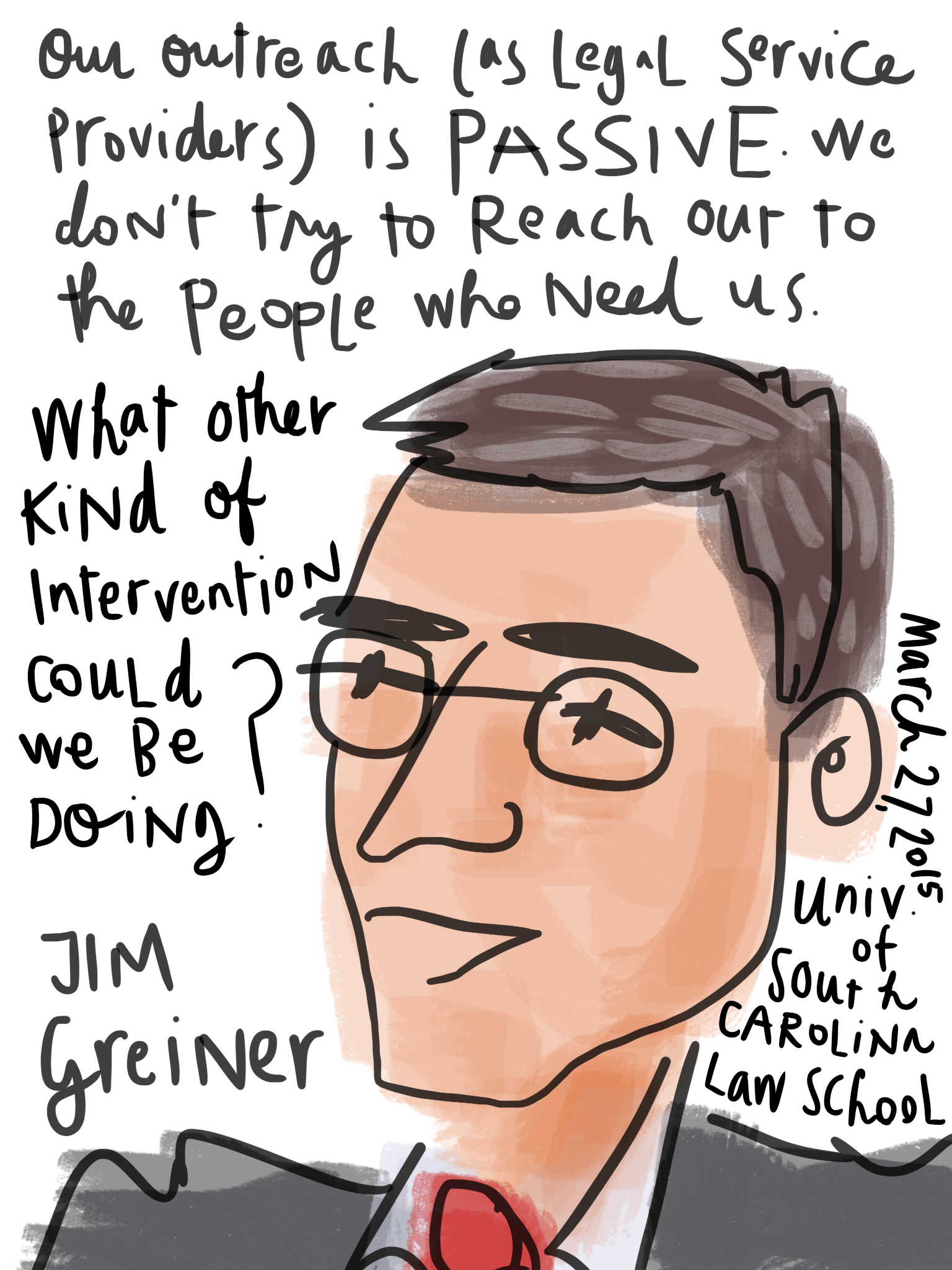
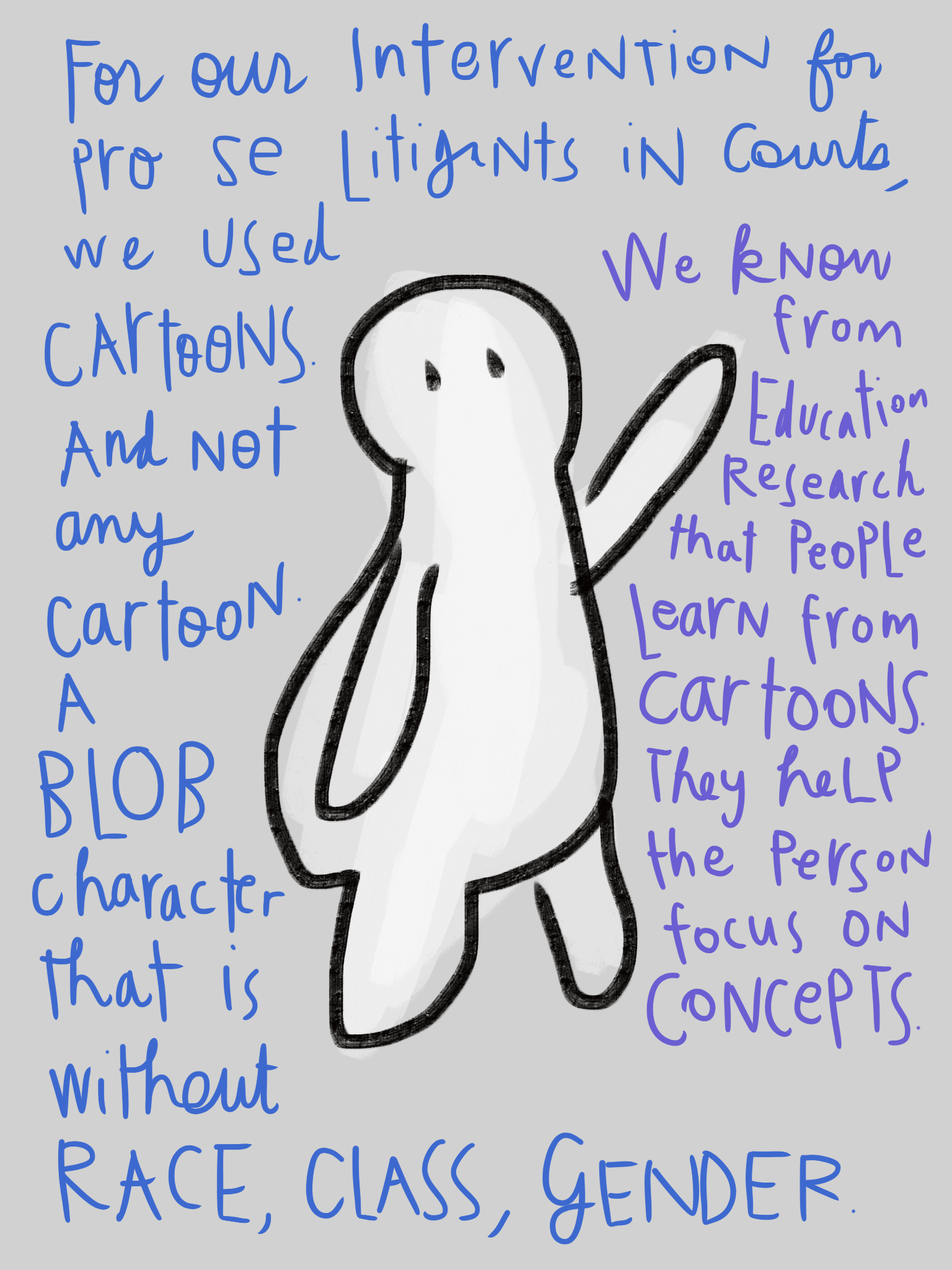
Some quick sketchnotes of a talk from Jim Greiner of Harvard Law School, speaking with Univ. of South Carolina Law School about how to engage people in debt procedures — how to get them to show up in court. They tried to reach out to people in debt proceedings with paper-based, cartoon-based interventions. They created a cartoon character and storyboards to explain the coming proceedings & try to orient and activate the litigants.
Open Law Lab - Margaret Hagan - Legal Services - Jim Greiner Open Law Lab - Margaret Hagan - Legal Services - Jim Greiner  2

Categories
Current Projects Integration into Community

Integrated Legal-Medical care at health centers

The National Center for Medical-Legal Partnership has a New issue brief on medical-legal partnership and health centers. Marsha Regenstein, PhD, Joel Teitelbaum, JD, LLM, Jessica Sharac, MSc, MPH, and Ei Phyu authored the piece “Medical-Legal Partnership and Health Centers: Addressing Patients’ Health-Harming Civil Legal Needs as Part of Primary Care.” You can download it as a PDF here.

The brief explores the link between social & economic issues — like income, housing, education, employment, legal status, and personal/family stability– and how civil legal aid and health care can combine to provide positive impact on these issues.

Civil legal aid becomes an ‘enabling services’ that allows people who have come in as medical patients to a health care facility to get the appropriate government services and support. Legal aid supplements and reinforces the medical care, by addressing root issues that have led to medical problems. Legal help in hospital help patients to deal with health-harming civil legal needs, like those around housing and utilities.

Medical-legal partnerships train clinicians and health care staff to know enough about the law to spot when a patient has a potential legal issue. Then this health care worker can hand the patient off to an in-house legal worker (who may be part-time or permanently at the facility) to get the legal support for their problem. Sometime the lawyer comes into the medical exam room, sometimes they may schedule a follow up off site.

The majority of patients seen at health centers are living at or below the poverty level, and because of this, they have unmet legal needs — related to housing, public benefits, education — that negatively impact their health. Medical-legal partnership is an approach to health that integrates the expertise of health care, public health and legal professionals and staff to address and prevent these health-harming civil legal needs for patients, clinics and populations. There are currently 60 FQHCs and Look-A-Like health centers that operate medical-legal partnerships with civil legal aid agencies across the United States. In the fall of 2014, HRSA released guidance, which clarified that civil legal aid services may be included in the range of enabling services that health centers may choose to provide to meet the primary care needs of their patients.

This issue brief explores the medical-legal partnership approach to health in the context of health centers. It is intended to help health centers understand the benefits – to patients and to their institutions – of partnerships with civil legal aid agencies, and to introduce additional resources that can help health centers implement these programs.

Categories
Current Projects Training and Info

Ideas for Know Your Rights redesigned

Last night, I helped organize a group of lawyers & designers to kick off a longer design process, about reimagining how we convey Know Your Rights materials to lay people. We had a great mix of people who work on Know Your Rights initiatives as a part of community law groups, legal aid groups, and advocacy orgs. And we had a few designers who are interested in making legal services better.

It was an introductory session — introducing the participants to the design process & the mission of user-centered legal design. But we got to start through developing some new ideas for Know Your Rights initiatives, focusing on certain users, use cases & needs — and then brainstorming out some initial ideas.

I will write up a fuller report later — for now, here are some of the brainstorms!

Picture Picture Picture Picture Picture Picture