Categories
Current Projects Training and Info

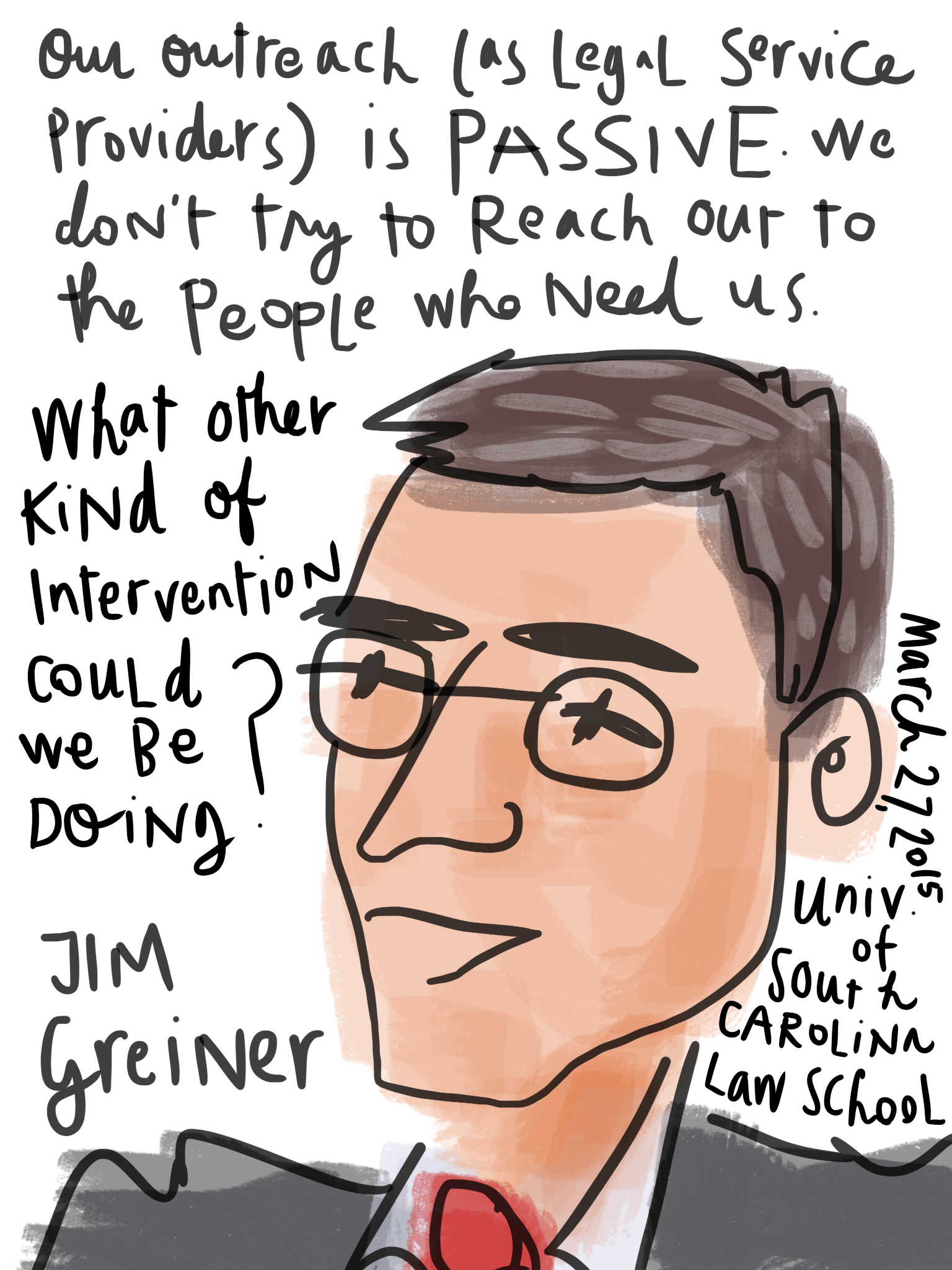
Cartoon interventions for legal engagement, from Jim Greiner

Some quick sketchnotes of a talk from Jim Greiner of Harvard Law School, speaking with Univ. of South Carolina Law School about how to engage people in debt procedures — how to get them to show up in court. They tried to reach out to people in debt proceedings with paper-based, cartoon-based interventions. They created a cartoon character and storyboards to explain the coming proceedings & try to orient and activate the litigants.
Open Law Lab - Margaret Hagan - Legal Services - Jim Greiner Open Law Lab - Margaret Hagan - Legal Services - Jim Greiner  2

Categories
Current Projects Training and Info

Ideas for Know Your Rights redesigned

Last night, I helped organize a group of lawyers & designers to kick off a longer design process, about reimagining how we convey Know Your Rights materials to lay people. We had a great mix of people who work on Know Your Rights initiatives as a part of community law groups, legal aid groups, and advocacy orgs. And we had a few designers who are interested in making legal services better.

It was an introductory session — introducing the participants to the design process & the mission of user-centered legal design. But we got to start through developing some new ideas for Know Your Rights initiatives, focusing on certain users, use cases & needs — and then brainstorming out some initial ideas.

I will write up a fuller report later — for now, here are some of the brainstorms!

Picture Picture Picture Picture Picture Picture

Categories
Ideabook Training and Info

Law content on Wikipedia

Last week, I was a facilitator at a Shaping Davos design thinking workshop at Stanford’s d.school.  Several local non-profits had brought some big social impact challenges they’re facing — around gentrification, housing, food waste, community-building, and information access.

Margaret Hagan - Wikipedia workshop - 2015-01-22 19.46.19

Then small groups of engineers, public policy-makers, business people, lawyers, entrepreneurs, and other professionals spent 2 hours brainstorming & prototyping possible solutions to these challenges. Our goal wasn’t to solve the problem then and there, but rather to start scoping target areas for future work and laying out promising directions for solutions.

I was working with Wikimedia (the non-profit that runs Wikipedia among other projects) on the challenge of how it can get more content from more kinds of people — especially people in the Global South — included on Wikipedia.Margaret Hagan - Wikipedia workshop - 2015-01-22 20.18.08

The group ended up generating some interesting ways to make contributing to Wikipedia more lightweight, multimedia, and interactive.  Many of them tied back to work I had done a few years ago on how the UN could support more communication & knowledge-sharing among refugees. But the really interesting conversation happened after the official event ended, and I got to speak to the UX designer from Wikimedia who was attending the event.

I inquired about how we might be able to get more legal content onto Wikipedia. Since my main focus these days is how the Internet can be a better legal service-provider, I have been thinking of how to rope Google & Wikipedia into more thoughtful efforts to show high-quality, localized, responsible legal information to lay people searching online about legal problems.

If Wikipedia entries are nearly always the top hits of a Google Search — and especially as their content is given prime real estate in highlighted boxes on many searches thanks to Google’s Knowledge Graph — wouldn’t it be wonderful if there were more high quality Wikipedia entries on legal matters?

I’m thinking especially of 2 use cases, where legal content on Wikipedia could be terrifically helpful:

  1. The law student who is trying to learn concepts, cases, and theories — and wants to do this with online content and references rather than the standard case book. (This was me as a law student — I was so disappointed to see how little legal commentary and expertise Wikipedia had to offer on what I was studying).
  2. The lay person searching for context & orientation for a legal problem that has cropped up in her life.  She is not necessarily looking to file papers, find a lawyer, or take any other concrete step along a legal process. Rather, she is trying to get literate in a legal topic & start to understand what this part of the legal world is about — and hopefully find links to jurisdiction-specific materials, if not actual legal providers.

Talking with Wikimedia’s UX designer, it seems there are several ways to get higher quality legal content onto Wikipedia, for both these types of users.

  • Get active inside the WikiProject Law to direct the creation of more legal content
  • Create a game experience over Wikipedia to feed and edit more content
  • Make Wikipedia content creation part of law school curriculum

One way is to be active inside the WikiProject on Law.  This is a collection of Wikipedia users who are trying to generate more quality content about law — covering everything from public policy to philosophy as it relates to law. Open Law Lab - Legal content on Wikipedia - WikiProject Law

If I — or you — wanted to join this WikiProject, we could help set out an agenda of what kind of legal pages should be created, and what the priority for content development should be.  The community is open to applications. New members can add to the group’s collective to-do list & direct content creation.

Another possibility for getting more law on Wikipedia is to build a new interface or app on top of Wikipedia.  One model for this is The Wiki Game.  A 3rd party developer built a web & app game on top of Wikipedia, that allows for content-consumption & -creation via quick, lightweight games.

Open Law Lab - Legal content on Wikipedia - The Wiki Game

This kind of venture would take some more work & inspiration. What would a gamefied experience of getting people to submit legal content to Wikipedia look like? Or could we gamify the checking, tagging, and editing of possible legal content? There could be a very engaging experience here, but I don’t have any precise thoughts on how something like ‘The Wiki Game’ could be adapted to legal content.

And the final idea — probably fairly feasible — is to integrate Wikipedia content creation into law school curriculum.  Could 1Ls be assigned the creation of Wikipedia articles for the topics and cases they’re studying? It would be nice to see all of law students’ study material be made open-source and usable by the crowd online.

Categories
Ideabook Training and Info

Access to Justice & self-representation tools

As I’ve been writing up a paper on new legal tools & an agenda for access to justice innovation — I keep coming back to the same point.
Margaret Hagan - what we need for access to justice

To really address the access problem, we should be focusing on scalable, modular tools.  They could be in the form of software & other tech — or they could take other forms: new roles, new organizations, new workshops, new services, new designs of forms & pamphlets.

But the basic point is the same: we don’t just need more lawyers (though this is certainly needed too), we need to be investing on ways to help people get informed about legal processes & give them tools to navigate them.  Even if we (as lawyers) would prefer people to only use lawyers to address their legal problems, this is not what most people want and they will try the DIY route.  We should be building the tools that allow for more responsible & competent self-representation.

Categories
Current Projects Training and Info

Immigration Game: Toma El Paso

Game design - legal game - Toma El Paso - Make a Move

Communication professor Lien Tran of the Univ. of Miami has developed an offline game for users of the US immigration system — called Toma el Paso, or Make  a Move.  It uses a familiar board game structure to present the legal system to the youth who are currently proceeding through it.  She developed it along with an immigration attorney, Shalyn Fluharty, and is rolling it out in the Immigrant Children’s Affirmative Network in Florida.

Game design - legal game - Toma El Paso - Make a Move 4 Game design - legal game - Toma El Paso - Make a Move 3 Game design - legal game - Toma El Paso - Make a Move 2

The game is specifically geared for youth from Central America who have arrived in the US and ended up in detention.  It challenges the players to navigate the legal system in order to get out of detention. Here’s the description from Lien Tran’s site:

Of the 8,000+ children detained within the U.S. each year, many are eligible for legal relief but are not guaranteed legal counsel. Immigration law is one of the most complex legal codes in the U.S., and it’s unjust that a child should have to navigate this labyrinth by himself without legal guidance. Games can make complex legal information accessible to a child so he can make more informed decisions and ask questions specific to his case.

In Toma El Paso (Make aMove in English), a game that teaches youth about the release from detention process, the mechanics provide tacit lessons detained youth do not always learn and yet should apply in real life.

Details on the game: it comes in English & Spanish language, it is comprised of the board game and a card deck, and it takes the players through the 3 possible pathways that a detained immigrant youth may go through to get released from detention: reunification, federal foster care, and voluntary departure.  The players have to interact with the same kind of people they will in real life, like lawyers and case managers.

Game Design - legal game - make a move immigration game 1 Game Design - legal game - make a move immigration game 2

An August 2014 article from the Univ. of Miami also interviewed different stakeholders from the law school and the legal services community about the potential of the game:

Last Monday, Tran visited “His House Children’s Home” in Miami Gardens, where 166 children between 11 and 17 years of age reside, to train 20 resident counselors who work with the minors how to use the game.

“This is a good way to engage kids with complicated information,” said Tran. “You can play with the children at any time.”

Available in English and Spanish, the game was first introduced at the shelter in April as part of the Immigrant Children Affirmative Network (ICAN), a youth program developed by faculty and students in the School of Education and Human Development that has been used for seven years to promote resilience and hope among unaccompanied immigrant minors in South Florida. To date, dozens of the youngsters have played the game.

“Professor Tran has created a remarkable tool to help educate these youth and bring joy to their lives at the same time,” said Etiony Aldarondo, associate dean for research at the school and director of  ICAN. “Most of us would be overwhelmed if we had to deal with the complex legal and social challenges faced by unaccompanied immigrant minors in this country. This game turns the stress of figuring out the uncertain pathways that lie ahead for these kids into a fun opportunity to learn.”….

The complexity of the legal process came as a surprise to Eddy, a 22-year-old FIU student who works with the detainees.

“This game helps us be more empathetic to their plight,” Eddy said. “We realize what they have to go through.”

Gina, a Haitian-American counselor who has worked with detainees for many years, said the game simplifies the legal process and can help minors cope with their situation.

“Many of the children are under a lot of stress,” she said. “Many come into this country escorted by strangers, and some are abused by these strangers. It is important for us to be vigilant to their needs and make sure they know that they are in a safe environment.”

You can purchase a copy of the game here at the Game Crafter site.

Categories
Current Projects Training and Info

Judgepedia & crowdsourcing court-user info

Open Law Lab - Judgepedia
I just found out about Judgepedia, a site that collects information about courts and judges, in a shared wiki. Its primary user seems to be someone interested in how the judicial system in the US works, and how individual jurisdictions have established judicial systems. It’s a project out of the Lucy Burns Institute.

Judgepedia aims to provide greater clarity to citizens about who runs the courts, how much money they spend, how elections are run, and how the system operates.
Screen Shot 2013-10-29 at 9.43.14 PM

It lets the user get straight to their local court system & try to navigate through how it is run & who the relevant judges are.

Screen Shot 2013-10-29 at 9.43.50 PM


You can look up a brief bio & information on a particular judge.

Screen Shot 2013-10-29 at 9.44.17 PM

This site is great in that it compiles disparate information that is available on lots of random sites around the web, and then creates a standard & searchable single experience for a user to more easily navigate.  The standardization is a great benefit.

Still, there is lots of potential to expand from this basic educational information & get to a new service for consumers of court services. When I first saw the title Judgepedia, I was expecting more info for the legal user — for someone who will be encountering the judicial system and wanting to know how to deal with a certain judge.

That kind of product would provide stats & metrics about lawyers and judges — which seems like a forbidden territory in the legal domain.  Even if such an evaluative product could be developed, it seems there would be serious vested interests that would block its implementation.

But still, that seems to be where the real need is.

The more I study legal consumers, the more it becomes clear that a main unmet need of lawyers & clients is to build better strategies to get legal tasks done. This is where there is huge promise in crowdsourced information.  If we can share information on what strategies work best within specific parts of the legal system & with certain judges — and which ones fail — this would be a huge benefit to litigants. Or if we could build a stats system that tracks judges’ behavior & preferences, this would similarly equip legal users with ways to better prepare their strategies.

The outstanding challenge, then, is how to gather, check, & share this crowdsourced information (which would be a huge undertaking in itself) — and to do it in a way that would survive challenges by lawyers, judges, and others who have a vested interest in resisting evaluation.

Categories
Advocates Current Projects Training and Info

FlyRights: Mobile Discrimination Reporting

The SikhCoalition has put together an ingenious app out to crowdsource reports of discrimination at airports and on airlines. If the government and companies won’t release information about how many complaints they have received, then why not ask people to report their complaints themselves?

The app lets a person report an incident as soon as it happens, and the report will be filed with the TSA & the DHS — and it will also allow others to maintain counts of how many incidents actually occur.

Open Law Lab - FlyRights 2 Open Law Lab - FlyRights

Categories
Current Projects Training and Info

Illustrated Guide for Immigrant Youth

The Immigration Legal Resource Center (ILRC) has put out a sketched-out (at least in part) guide for a young non-citizen audience — trying to equip them with some basic legal knowledge & set of strategies.  Some excerpts are below.  There are a lot of great starting points in the PDF — though I would advise moving away from the “Pamphlet Approach” ASAP.  If it lived on a scrollable or sliding website, at least that would be a minor step in the right direction >> away from bulky online pamphlets, towards a lightweight and mobile-friendly interface to bring the target audience in contact with this info.

Open Law Lab - Youth Undocumented Immigrant 1 Open Law Lab - Youth Undocumented Immigrant 2 Open Law Lab - Youth Undocumented Immigrant 3 Open Law Lab - Youth Undocumented Immigrant 4 Open Law Lab - Youth Undocumented Immigrant 5


Categories
Current Projects Training and Info

Law High Schools

Screen Shot 2013-04-15 at 8.48.34 PM Screen Shot 2013-04-15 at 8.48.47 PM

I’ve been searching around for pre-college legal curriculum. When is law taught to young people in America, other than in pre-law classes in university?

I took a Civics class in my public high school, which reviewed some basic First Amendment rights, and was oriented around the rights of young people. It was enjoyable enough, but also taught by the school’s gym coach and not taught with much rigor or expectation.

In my basic Internet searches, I’ve found there are a handful of new Legal-oriented charter schools popping up around the States. The schools’ websites are fairly limited, so it is difficult to pinpoint exactly what kind of legal curriculum they are teaching, or what methods and tools they use to do so. I’m excited by the promise of youth-oriented legal education.

California has two legal charter schools — Pacific Law Academy in Stockton, and Natomas Pacific Pathways Prep in Sacramento. The schools were created in partnership with University of Pacific Benerd School of Education and Pacific McGeorge School of Law. Natomas was founded in 2006, and some of its law courses are developed along with the McGeorge law professors, including topics on the foundations of law and criminal law.

Open Law Lab - Legal Prep Charter Academies - Course Requirements

Chicago’s Legal Prep Charter Academies is a legal-themed high school that opened in August 2012 with 200 freshman students enrolled. It’s located in South Side Chicago, in the West Garfield Park neighborhood. It will be adding a grade per year until it has 4 grades with 800 students.

Legal Prep’s mission is to prepare Chicago’s youth to succeed in college and in life. Through a rigorous curriculum and a culture of high expectations, Legal Prep will empower its students to achieve their full potential. Legal Prep will focus on the skills that all great lawyers possess: excellent written and oral communication, critical thinking, problem solving, and advocacy. While not all of our students will go on to be lawyers, all students will gain an appreciation and respect for the law. These “21st century skills” will prepare students for success in any number of postsecondary paths.

To help accomplish, Legal Prep is working with the entire Chicago legal community and other area businesses to provide the resources and exposure to our students so that they know that they can excel in college and pursue a legal education. There are numerous ways for corporate legal departments, law firms, bar associations, and individual attorneys to be involved so please let us know if you are interested in supporting Legal Prep or would like to learn more about the school.

It does not have an explicit list of the courses it offers, but the school says that it will prioritize legal topics in education.

Legal Prep will offer its students a college prep curriculum with legal topics infused into the core subjects, where appropriate. Legal Prep will also provide law-themed courses and extra-curricular activities. The legal content is a way in which students can learn and hone their writing skills and oral presentation skills, as well as apply logic, analysis, and critical thinking to legal issues. Law curriculum uses strategies that engage students in learning, foster civic participation, and promote meaningful relationships with professionals.

Diverse attorneys are vastly underrepresented in the legal profession – only 11% of attorneys are diverse, compared to 36% of the U.S. population. Legal Prep presents an exciting way to increase the pipeline of diverse students to the legal profession. Legal Prep will not only provide exposure to the legal profession and attorney support, but also prepare students for the rigors of college and professional life.

Legal Education Pipeline

Categories
Current Projects Training and Info

Compliance Law Games

I just came across the company TrueOffice that is putting together (inspiring!) games for businesses to train their employees on ‘compliance’ issues.  Think sexual harassment, information security, or ethical behavior in the office.

TrueOffice - Compliance Training

The issue is that these trainings are typically boring, unimpressive, without lasting impact — more of a burden on the employees than a lasting instructional session.

TrueOffice takes a ‘Gamification’ approach to the problem (with strong reliance on the attraction of narratives, comic books, and police procedural tv shows).


Their market is clear: businesses that are obliged to train employees about certain rules & policies, and then provide some assurance that the employees have digested the training.  Their approach, though, holds lots of inspiration for a wider range of markets and possible products.

Though these game apps are marketed as enterprise solutions for ‘compliance’ — they are bordering on the world of law.

It uncovers a few insights that could be used for legal service delivery & legal education:

  1. Embed what you want to communicate — laws, rules, strategies, etc — into larger narratives — if the apparent point of an experience is more to follow the story, find out the outcome, or solve a problem — and less just to intake material for the sake of remembering it long enough to pass a test — the user will be more engaged and more likely to be actively learning the material.  It is better to teach through experiences, narratives, storylines, and personas, than to just teach the material cold, section by section. This has clear implications for how we educate lawyers, but also holds true for other communications.  How we communicate to clients, to juries, to others we are trying to persuade or educate — we need to embrace users’ love of stories & narratives, and use this for its persuasive & engaging force.
  2. Give users ‘agents’ or ‘personas’, whose roles the user can take on — this will help the user see situations more critically, and from different kinds of perspectives than their own.  This may be particularly important in training lawyers.  It may also be a playful tool for legal service delivery, in which the client needs to do more self-diagnosis or self-service — this persona-playing may provide a reflective space for better information sharing & engagement with online legal services. Users like to be active — and in created virtual worlds, they are willing to make leaps outside of their typical mental models & expectations, and perhaps also be provoked into new modes of thinking, planning, valuing, and action.
  3. Provide quick feedback, regularly throughout the experience — whether in the form of check-in quizzes, or progress bars, or a user journey map which will show the user that they are making progress — and will help them locate themselves on the overall service’s map.  Don’t wait until the end of an experience to tell the user how they are doing, or provide encouragement or other feedback.  Weave it throughout the experience, and the user will be much more engaged.  That’s a more general lesson — to ‘onboard’ users into a product, system, or even a conversation, you must give quick easy rewards, and then steadily make the experience more challenging.
  4. Play can work in the workplace — if TrueOffice is to be believed, employers and employees both have an appetite for games, cartoons, and other ‘play-like’ experiences to serve work purposes.  Perhaps law firms is another frontier — in which such ‘play’ will not be allowed for a good while — but I take it as a positive that some ‘serious’ workplaces may be inching open to more inventive, interactive, and creative approaches to delivering services.

trueoffice1

I have scouted around for some info on whether there is a market there for TrueOffice.  They’re a fairly young venture out of Boston, and it seems in January 2013 they received $3mil in Series A funding from, among others, Rho Ventures, the Partnership for New York City Fund and Contour Venture Partners (as reported by Kyle Alspach in the Boston Business Journal).

True Office said the funding will be used to expand its business within the financial services sector, and to move into other highly-regulated markets such as health care.

In the release, Sodowick said there are currently few options for businesses to effectively help their employees understand regulatory and compliance issues. But, he said, “a well-designed game has the power to engage employees and at the same time, produce analytics that can help the banks identify and reduce operational and compliance risk.”

TrueOFfice - 2 TrueOFfice - image 3