In late April 2018, Daniel Bernal and Margaret Hagan taught the first part of the d.school pop-up Design For Justice: Eviction. The class focused on how we might better empower people who have received eviction notices (specifically, in Arizona) to know their rights, their options, and to go to court to fight eviction.
In the class, our 2 teams focused on what intervention we might send in the mail to activate someone right after they have received an eviction notice, and what intervention we might point them to for greater support and guidance.
We worked in 2 phases. First, we did a recap of key insights, personas, players, and trends regarding the eviction process, user experience, and legal help resources in Arizona. We did this with calls to Arizona legal help leaders, a service designer who has been working on eviction help, and Daniel’s presentations on his research into eviction trends and strategies in Arizona.
Our second phase of work was brainstorming and prototyping. Our 2 teams focused on the different intervention points, to create an Idea Catalogue of possible ways to empower users through a mailer or a digital resource.
From this brainstorm, we critiqued the ideas with some help from our frequent collaborator, Kursat Ozenc, who is a design strategist. We will now write up these ideas, formalize them slightly, and invite a panel of legal, sociology, behavior change, technology, and design experts to give further feedback. From there, we will begin to develop first versions of several of the concepts that we will test with the public in our second half of the class.
This quarter, I’m co-teaching a class, Community-Led System Design with Janet Martinez at Stanford Law School/d.school. We are bringing various innovators who are doing human-centered design work in government and legal systems. We, and our students, will be documenting what we learn during this class from our guest speakers and our own work.
The Public Policy Lab team presenting at the d.school
Our first visitors were Chelsea Mauldin and Shanti Mathew, from Public Policy Lab in New York. We have admired their work on affordable housing, social support services, and public health work — all done with tremendous respect for the communities they’re serving and methods that put community-members’ voice at the center of decision-making.
The Public Policy Lab’s website
Chelsea and Shanti joined us virtually from their New York office, to discuss their approach, their projects, and insights for future public policy innovators.
As you can explore on the website, the Public Policy Lab team works with municipal and federal agencies. As a non-profit, the Public Policy Lab is an independent group, but they work closely with partners inside the government to create new initiatives to better deliver services and support to the public.
They work at a core point of friction: between the policy-maker’s point of view, which often is utopian, rational, and bureaucratic — and members of the public’s point of view, which often is pragmatic, cognitively overloaded, and disempowered.
Finding how to move forward, with a tension between Policy-Makers and The Public
They have figured out ways to use design to better identify opportunities and test them. This means going through a few phases — of doing research and identifying key problems and opportunities, then co-creating, prototyping, and testing with community members, and finally refining and doing storytelling and market-building.
Stanford students mapping out design process to use in tackling legal system challenges
If you do one project with a policy-maker, you might set a new example inside the organization. A human-centered process can change the posture of the agency toward the public they serve — there are ripple effects on how people in the agency interact with the public, and how they set up services.
How can you find the right partner?
Some possible project partners are motivated by the group’s own concern for some big societal issues — and other times it is the government agencies who come with issues (sometimes with funds or not). Some of the work is funded by philanthropic grants.
The Lab team has found wonderful partners in the government, who are smart, dedicated policy-makers — who are passionate and engaged. What is challenging is that public agencies are complex entities, so there is a huge number of moving pieces with distributed authority. Some of the challenges that have arisen:
How can you make change in a complex system that isn’t particularly top-down (one person can say change this, and everything changes)?
To what degree do our partners have power and influence? We need to come up with a plan that speaks to their power and constraints.
When the Lab is scoping partners, they need to define ‘What does success look like?” and “Who is involved in this system”? There will never be enough time or money to do all the things the group wants to do. So they ask:
What do we want to get to? Let’s define success concretely.
Who are the people involved in service-delivery? Whose agreement do you need to get to make changes on the ground? If they want successful implementation, they are going to need to get them on the board.
How can you work well on System Design?
One big lesson they offered: No conference calls — you need to be in the same room together, especially if they are going to tell you anything uncomfortable. You should do some stakeholder mapping exercise with your partner — who are the individual types of humans involved in the decision-making they are talking about, who are the actual humans — it is Mary and Bob to convince to get them on board.
Starting our System Maps in class, of the Guardianship Legal System
Usually they do a half-day workshop, to cover big topics like ‘what are we doing here’, ‘ have the partners talk about it’, ‘we visualize it as they talk about it’, ‘how will we define success’, ‘what are we going to make’, and the logistics of how we’ll do it.
How can you plan for resistance to change?
You can assume there will be people who will resist change. You will never expect people to do what they don’t want to do.
You need to design it for uptake. You need to design what people will embrace because it will benefit them. That’s why to start with observational research — how are people working around the problem, what are the strategies they are already using? Use people’s current behaviors to design for those outcomes. You can amplify the current behaviors, so that they are likely to do what you are expecting.
Can you find a design space where people all want the same thing? You want to find a space where there is alignment.
In addition, you need to see the people in the field, who have capacity and boots-on-the-ground. Who has extra knowledge and assets that you could use in a new program design? You can then activate those resources.
The trickiest population is mid-level management, whose job satisfaction and success aren’t directly affected by the system you’re trying to improve, and who don’t have lived experiences with it. They won’t have as much skin in the game.
What are main challenges to get engagement and involvement
Getting access to people — especially the right people, is more challenging than you would expect. It’s never that easy to get approvals.
The Lab believes in meeting with people in their space, so you are not the ‘expert’ in your ‘focus group’ — but rather in their kitchen, and you are a guest in their home, to learn about their lives. It takes someone whose job it is to arrange those research opportunities, hours on the phone or on text. The logistical challenge is huge, but it is worth it.
Once that happens, then people are incredibly generous with their knowledge and experiences and follow-up. They’re almost always kind and helpful to the process.
If it’s impossible to do substantial, one-on-one engagements — and you have to do ‘Stranger’ research, like a card table in the lobby and intercepting, you can get a lot of knowledge, but you won’t have an ongoing relationship. That may be okay, but know the limits of what you are able to understand about these people.
Often the Lab does rounds of research and testing with different populations, because it’s impossible to get the same people back. You get fresh eyes looking at your work every time. Your design has to work harder.
They always compensate members of the public for their time. But don’t give so much that you are buying their answers — so that you are paying them for what you want to hear.
Thinking through ethics and consent during design research
How to be ethical, and get quality consent?
How do you do informed consent — it is hugely important. Let’s talk about consent procedures. The work designers do is inherently exploitative — we extract people’s experiences and input, then turn around to make something that will not necessarily benefit them directly. We need to be clear on that as our team, and with that knowledge in our team — we are aware of it.
The Lab encourages us to reframe Consent. Instead of consent oriented around protecting your organization — so you won’t be sued, can consent rather be about what the person should expect. So that people know that photos, audios, etc. might be shared out — you are using someone’s face to sell your work, do they understand it? Do they understand where their image might end up? If we take a photo of them, do they know what will happen with it — that it might be on the Internet.
Also, can you aggregate stories, so you are not exposing a single person? We try to get away from anything that could identify a person. We create personas based in research, but they are so aggregated that there is no single person’s life recognizable there.
Especially if a person has less agency — like a child, a person in prison, a person in the hospital, a person with mental illness — we need to be even more transparent with what we’ll do, and what to expect.
During the process, we need to work as hard as we can to strip our own professional authority away — and give the power to the user. Give them final oversight of whatever you’re creating, and ask them for what they would change.
Evaluation and Metrics
The Lab is working on our own evaluation process, because it’s very complicated and it’s hard to determine causality. It takes a long time — how do we actually see changes? It might take 4–5 years after the policy design happened. What do you measure at what point?
When we define a Theory of Change at the outset of our project — we think about evaluation in a few different ways:
How do we measure the design of the thing?
How do we measure the experience of the partner?
How do we measure how policy and organizations change?
The Lab can measure output (kids show up to school; kids aren’t as hungry; people are less poor) for program evaluation. That is often outside their scope of their project partner engagement. They can measure compliance: are staff referring families, are they filling in the form correctly, are families getting set up with a case manager? Those are actions in the program that they can track.
In a past project, they had made lots of design artifacts and strategies, so they could then evaluate: did the partner put posters up, did they table at the school fair, did they send the text messages? Those are our design evaluations, to see if the new system worked. This is formative research, to learn what to design — to see are they working, and how they are not working. The evaluation helps them learn how to redesign.
The Lab is trying to flick multiple levers — not just a single form, they’re doing multiple touch points across a service journey across time, and it’s about human interactions, not just a single form. How do you track systems-level impact? It’s a huge question, that they’re working on.
Many thanks to Chelsea and Shanti for visiting our class, and we are looking forward to seeing more of their work! Read more about the Public Policy Labhere.
In Community-Led System Design, a Stanford Law School/d.school course this quarter, we are speaking with people working on systems- and policy-design projects, from a human-centered design perspective. One of our guests was Verena Kontschieder, a visiting research student at the Center for Design Research.
Verena at our class
Verena’s topic was the growing number of Policy Labs in governments and intergovernmental organizations — and how more policy-makers are using design approaches for better governance and systems change.
Verena’s talk, illustrated by Margaret Hagan
Design approaches to crop theft
Verena began her talk with a case study how design is coming into policy-making: regarding praedial larceny in the Caribbean subregion.
Praedial larceny is the theft of growing crops. It had been the most significant crime in the region for over two decades, with its rate of occurrence only rising.
At the international governance level, policymakers and the Food and Agriculture Organization had been conducting constant research on praedial larceny in efforts to reduce the problem. They found that only 45% of all cases were reported and traced. They interpreted this as being due to the inertia of the region’s police forces, which led to wide frustration and distrust among people. Still, however, they were not able to improve the situation, and the occurrence of PL continued to rise.
Three years ago, the FAO decided to try a new approach. Together with the World Bank, it worked with multiple NGOs, civil society organizations, and trade unions to conduct on-the-ground design work. These organizations interviewed hundreds of people who had been affected by and involved in praedial larceny in some capacity. Very quickly, they discovered that the problem was not the police; rather, it was a combination of shame and societal structure. People were not reporting cases of praedial larceny out of a fear of being marginalized, as the stigma of being an informant in that society was just too high.
This case study was significant for me because it vividly illustrated how research at the international governance level can fail to capture the reality of the people on the ground (such as for over 20 years in this example!). As Verena pointed out however, it is important to remember that both these approaches are valid, albeit in different contexts.
The rising Labscape
This case study also illustrates a shift in paradigm that is currently occurring worldwide. Verena called this a shift towards “labscapes”, i.e. policy labs working across landscapes while also acting as a “safe place to do dangerous things”. This lab movement is driven by academia, business, government, and the private sector, and has been particularly prominent since 2012.
Verena’s talk, illustrated by Margaret Hagan
These policy labs, such as the African Development Bank Policy Innovation Lab and the Laboratorio de Gobierno, are taking on different shapes and formats, but the nature of their existence is similar. They are all working to enable stakeholders to come together in a physical space in the face of complex policy changes in manners not addressable in traditional institutions, while at odds with traditional policymaking.
Verena also discussed her own Ph.D research, which consists of multi-sited case studies on policy labs at the international governance level, with the goal of examining the intersections of innovation, policy, and design.
Verena’s talk, as illustrated by Margaret Hagan
One of her key findings thus far is that there is an institutional vs. individual level break in the labspace. Policy and society are detached at various levels; policymakers and institutions lack transparency and often even direct accountability, and there is, as a result, a sore lack of institutional trust on behalf of citizens, who feel extremely alienated from these higher-up levels of governance.
Verena’s talk, as illustrated by Margaret Hagan
Verena emphasized that humility should be a key aspect of any design process — as designers and policymakers, it is important to know that we are fallible and no longer the experts. Rather, we need to be sourcing the experience and knowledge of communities directly affected by the issues we seek to tackle. Verena also raised the question of what the role of policy and policymakers should be, and whether it should just be one of enabling NGO’s and/or the private sector to tackle social problems.
Verena’s talk, as illustrated by Margaret Hagan
Verena ended by raising several thoughtful and important questions that are emerging from her research:
1. Are policy and political incentives misaligned? Is innovation possible in the absence of market incentives?
2. Are out-of-lab policy initiatives not innovative? If not, why is innovation not happening outside the lab?
3. As designers, should we strive to reformat entire organizational systems, or let design trickle down organizational hierarchies to produce meaningful change?
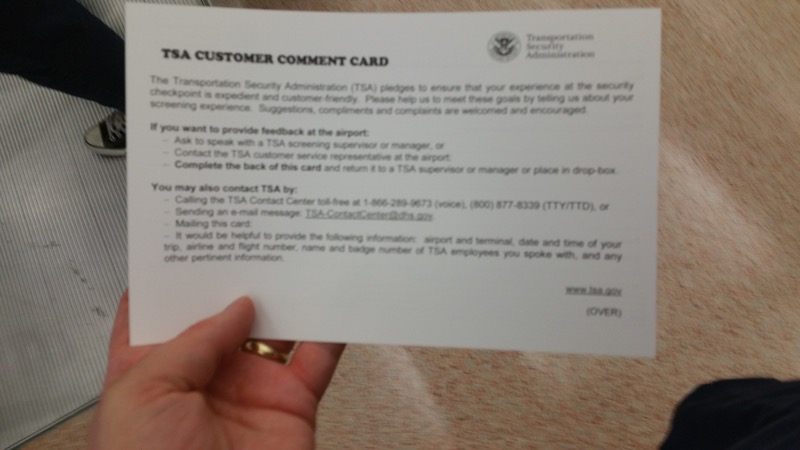
More analogous learning from airports, this time from Dulles — and all their feedback prompts and props right around the security experience. These are all posted around the TSA, for people who have just gone through their pre-flight screening, to get feedback on the experience.
I have been scouting out service design inspirations, particularly from airports, that courts could use. This one is from JFK airport, in the Delta terminal. I was very impressed with their service design. They had taken over an entire gate with a help center that had all kinds of touchpoints: paper, phone terminals, people, kiosks. There were multiple entry points and lots of capacity, so that people could self-sort depending on the magnitude of their issue, the speed they needed it resolved, and their comfort with tech.
Of particular interest: the Need Help card. Can we make these for all courts?
Going to small claims court can be nerve racking, costly and time consuming. #B4 Small claims is an online dispute resolution app that will help people resolve claims of under $2000 in a quick, efficient and user-friendly way! No more complicated forms!*
Osgoode Law School’s Justice Design program created a prototype for Law Speak, a tool for people going through the small claims process who are not fluent in the dominant language.
LawSpeak empowers those who may not speak English as a primary language to navigate the small claims court process. This app translates documents, keeps them in one place and provide additional features like a location services option that will help you find your way to the courthouse.
A team from the Winkler Institute’s Justice Design 2016 class created a game Legal Go, inspired by Pokemon Go, but for learning law. It’s a way to train lay people on what the legal system is and how it works, through a mixture of in-person adventures and on-the-phone characters, challenges, and rewards.
Their description:
Inspired by the Pokémon Go phenomenon, Legal Go is augmented reality legal education game that makes learning about the legal system fun and interactive. As you wander the city you can complete missions that will help you build skills in empathy, understanding the legal process, finding legal and community services, and resources.*
In the article, Hardenbergh profiles the move to use the space of courts to make the judicial system more accessible, navigable, and open to the public. It is because of the increasing focus on service design and customer-oriented services.
This means more spacious waiting rooms.
Better public information and signage.
More support for child care and entertaining environments for them.
Concern and protection for victims and witnesses.
More pleasant treatment of juries.
Easier access to information and services.
Interventions to reduce waiting times and lines.
This means more working spaces and areas for pro se litigants, in particular, as well as more working spaces and counters for people who are trying to carry out tasks.
East Bay Stand Down is a project offered in California in which at-risk and homeless military veterans can access all kinds of service help over four days. It includes medical and dental care, housing, driver’s licenses, court services, hygiene, and more.