 A tool that would read contracts & legal documents so that you don’t have to. It would boil it down into key things that you should know — the essential conditions, trade-offs, etc.
Categories
Legal Reviewer

 Justice Innovation
A tool that would read contracts & legal documents so that you don’t have to. It would boil it down into key things that you should know — the essential conditions, trade-offs, etc.


Could we have a tech-based companion for people going through a court process? It could have timing advice, location directions, and other support to make sure the person is prepared for their day in court.
The value of this design would be to coordinate all the resources into a single place — the app. It would assemble and time out the information, and remind people of it.


An idea to allow a person with a legal decision to make to play around with possible variables & the outcomes that would result. It would be a way to see multiple different scenarios, and weigh options before making a decision.


The National Expungement Project. is a Maryland-based effort to guide people with a criminal record through an eligibility check (can I expunge my record) and then direct them to how they can follow through on this procedure (where can I find good — and maybe even free — legal help?). Right now, there is a Beta version of a Maryland-based version (ExpungeMaryland.org) and there are plans for more states’ versions.

The project is run by two JD/technologists based in Baltimore — Jon Tippens & Jason Tashea. Their vision:
In search of a better way, we created ExpungeMaryland.org for a local non-profit. It’s a web app that connects people who need an expungement with volunteer lawyers.
Since creating ExpungeMaryland, bar associations, legal service providers, and even a state supreme court have asked us about using tech to improve access to expungement in their states. Our experience building ExpungeMaryland and other projects makes us adept at scaling this project nationally.
Our vision is to bring expungement apps to 25 states by partnering with local stakeholders. This will capture 80 percent of the U.S. population, and 75 percent of its annual arrests. We will also make the code available to any other states interested in replicating the project.
Here are the interface flows —


Could we create a collaboration platform & network that would provide a holistic service for a person with a legal problem — so they have all the different kinds of support they need?

Last week I was at a symposium at the Univ. of South Carolina Law School, all about access to justice and doing more empirical, data-driven research about how to create better & more impactful access initiatives. Karen Lash, the Deputy Director of the DOJ’s Access to Justice Initiative, presented on what the federal government is doing to address civil legal needs in the US.
In 2012, the White House Domestic Policy Council & the DOJ launched a working group (the Legal Aid Interagency Roundtable) that would explore how diverse federal agencies could include civil legal aid needs in their agendas, to help improve their specific objectives. The driving insight is that legal aid can help all kinds of problems not typically thought of as “legal problems” — like health, housing, education employment, family stability, and community-building.

The Roundtable group has released an online Toolkit, that provides a roadmap to ways in which legal services can be used by other — not specifically ‘legal’ groups — to serve vulnerable & underserved groups. The toolkit is available on the DOJ’s website — here are some of the pages & resources covered.

And here are photos of the Toolkit as printed out in a hard copy. It has lots of explanations, stories, and resources to begin thinking about legal aid in a more holistic way — how legal processes can help a person with other ‘social service’ problems.


I am excited by this multilateral, collaborative approach to civil legal aid. Since most people don’t think of their problems as ‘legal problems’ (even though they could use legal means to address them) — and since many social service providers & government workers don’t understand the power of legal channels to address root causes of other social problems — we as legal professionals need to be better at explaining how legal aid can help them in their mission to serve their clients. And we need to give clear, procedural ways for them to access legal support for their clients.


A sketchnote of the start of a talk from Stephanie Kimbro, speaking at Univ. of South Carolina Law School about her research on how games & gamification mechanics and motivators could be used to improve the delivery of legal services.s

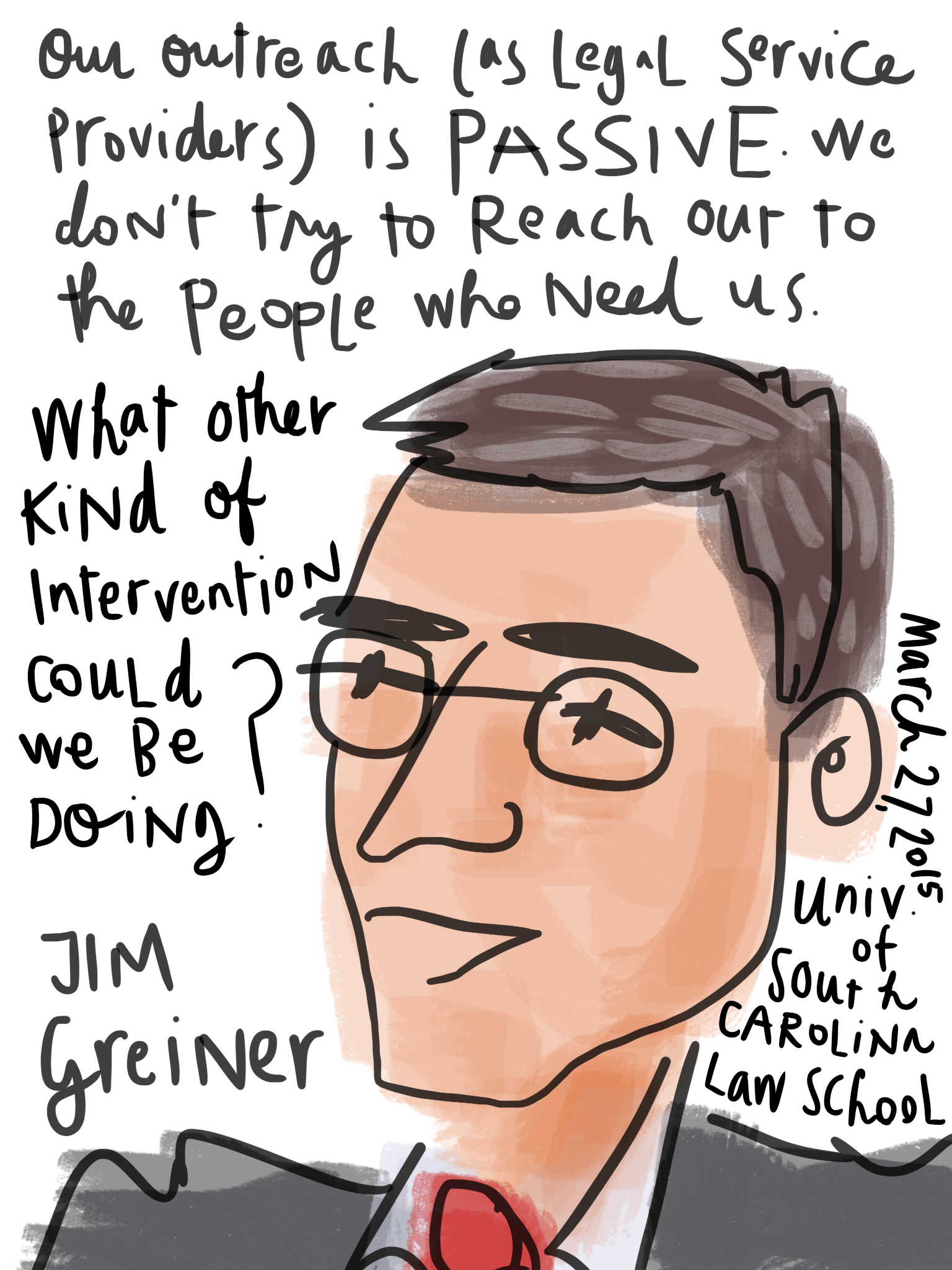
Some quick sketchnotes of a talk from Jim Greiner of Harvard Law School, speaking with Univ. of South Carolina Law School about how to engage people in debt procedures — how to get them to show up in court. They tried to reach out to people in debt proceedings with paper-based, cartoon-based interventions. They created a cartoon character and storyboards to explain the coming proceedings & try to orient and activate the litigants.

I’ve been thinking systematically about the suite of tools that we need to be building for better access to justice. I wrote earlier about the different product families — what some of these different camps of tools are. One I’m circling around with some intent is the Triage Tool.
A triage function would help take a person searching for legal remedy, and help them figure out what their condition is called in legal terms and what legal processes are open to them to achieve some kind of resolution.
Other terms for Triage tools: Eligibility-Checkers, Diagnostic Tool, Intake-and-Bucketing.
The main task of the triage tool is collecting essential info from the user, and then matching it with the system’s rules about what terms and paths fit their info.
I’ve been collecting many different examples of tech-based triage tools, and I’ll be publishing a pattern library with a discussion of what the main types of triage tools are, with examples of each. In the meantime, here’s a sketch I made as I start to group together this typology.

Do you know any triage tools that you think work well? Send me links, images, or write-ups — I will include them in my pattern library!

The National Center for Medical-Legal Partnership has a New issue brief on medical-legal partnership and health centers. Marsha Regenstein, PhD, Joel Teitelbaum, JD, LLM, Jessica Sharac, MSc, MPH, and Ei Phyu authored the piece “Medical-Legal Partnership and Health Centers: Addressing Patients’ Health-Harming Civil Legal Needs as Part of Primary Care.” You can download it as a PDF here.
The brief explores the link between social & economic issues — like income, housing, education, employment, legal status, and personal/family stability– and how civil legal aid and health care can combine to provide positive impact on these issues.
Civil legal aid becomes an ‘enabling services’ that allows people who have come in as medical patients to a health care facility to get the appropriate government services and support. Legal aid supplements and reinforces the medical care, by addressing root issues that have led to medical problems. Legal help in hospital help patients to deal with health-harming civil legal needs, like those around housing and utilities.
Medical-legal partnerships train clinicians and health care staff to know enough about the law to spot when a patient has a potential legal issue. Then this health care worker can hand the patient off to an in-house legal worker (who may be part-time or permanently at the facility) to get the legal support for their problem. Sometime the lawyer comes into the medical exam room, sometimes they may schedule a follow up off site.

The majority of patients seen at health centers are living at or below the poverty level, and because of this, they have unmet legal needs — related to housing, public benefits, education — that negatively impact their health. Medical-legal partnership is an approach to health that integrates the expertise of health care, public health and legal professionals and staff to address and prevent these health-harming civil legal needs for patients, clinics and populations. There are currently 60 FQHCs and Look-A-Like health centers that operate medical-legal partnerships with civil legal aid agencies across the United States. In the fall of 2014, HRSA released guidance, which clarified that civil legal aid services may be included in the range of enabling services that health centers may choose to provide to meet the primary care needs of their patients.
This issue brief explores the medical-legal partnership approach to health in the context of health centers. It is intended to help health centers understand the benefits – to patients and to their institutions – of partnerships with civil legal aid agencies, and to introduce additional resources that can help health centers implement these programs.