For our Design for Justice: Language Access class, our teaching team made a canvas to help a design team craft a forward plan for the projects they have been working on to advance language access in the courts through technology. The canvas can be useful to have a one-page hand-off for a policy partner to understand what the team is proposing, and how it can be taken to the next stage of piloting and evaluation.
Entering home stretch of the Autumn quarter, we spent today’s class first synthesizing our findings and working on our final pitch to the California Judicial Council and then selecting one of our prototypes for further development.
To start the the synthesis process, we grabbed a whiteboard and divided it into two halves — with one side dedicated to answering “What we heard or saw?” and the other dedicated to answering “What do we do in response?” Starting with the former question, we started jotting down quotes and experiences we had catalogued over the past few weeks from our interviews and observations, before clustering them around common topics. This exercise yielded two incredibly salient themes that we hope to address with our revised prototype:
Time: People fear the courthouse, because it takes an inordinate amount of time and as a result deprives of economic and educational opportunity that they would be accumulating, had they not spent hours upon hours and days upon days within the courthouse. One woman we interviewed exclaimed that, “divorce right now is almost a full-time job”; while another lamented that the amount of time she had to spend in court affected her kids’ academics, as they had to accompany her so that she could have the proper assistance necessary to fill out the English-language forms.
The process of getting proper help seems to take too much time because the self-help desk is understaffed and because court users produce a large number of errors while filling out their paperwork. Many of the people have interviewed over the past several weeks have mentioned that they often spend several hours waiting to be helped, only to be told that they made a mistake in their documents and are then sent to back the of line to seek guidance.
As a result, we witness a vicious cycle. The self-help desk is constantly creating its own backlog of requests, ultimately increasing stress and time allotted per case — for both the clerks and the court users. As a result of this feedback, one of our primary goals is to reduce the amount of time that a user has to spend in order to fill and submit their proper paperwork. This will help users have a more pleasurable and accessible court experience, while reducing the stress upon the self-help clerks.
Language Barriers Are Multifaceted: One thing we did not realize until we began user testing was how multifaceted of a problem language barriers actually are. When presenting our “Redesigned-Form” prototype to non-native speakers last week, we established a situation where we asked our interviewees to file for divorce. On the second page of the prototype, we asked our court users to declare whether they wanted a “Divorce”, “Legal Separation”, or “Nullity” from a “Marriage” or “Domestic Partnership”. While it was clear to the user that they were on a page associated with divorce, they were unsure as to what the differences were between a “divorce”, “legal separation”, and a “nullity”. As a native English speaker these terms seem foreign, as they are rooted in precise legal terminology; so one apparent aspect of “language access” is to provide court users with simple language that unpacks these precise terms. But the problem with language access extends far behind legal terminology and words in different languages. There are often significant cultural barriers as well. When interviewing a technologically-savvy Uyghur woman, we saw her even tried opening Google Translate on her phone, writing the phrase, and having the service produce a Mandarin version of the text. The problem was, however, that the concept did not exist in her culture; so even though she had the translated phrase, the concept did not register. This highlights the fact that language access does not simply include English-barriers, but also cultural ones. We must overcome both in order to provide true access to court systems.
With this in mind, we shifted to the other half of the board, answering “What do we do in response?” Here are a few of the ideas from that brainstorm:
Split the current forms into manageable chunks so that we do not overwhelm court users and narrow context of any page down to a singular topic so that it become easier for a non-native speaker to identify the goal of the page, even if they struggle to understand the bulk of it.
Provide native-language instructions and definitions that unpack legal ease in laymen’s terms and pay attention to cultural differences, in their explanations of legal terms.
Add legal advice forums like r/legal-advice into the court website; and provide a platform for non-native speakers to voice their experiences to others within their communities. We heard from many younger court users, that they looked online to blogs in order to understand the experience they were about to undertake, as a user of the court. These blogs reassured them and provided guidance, when they were most confused. It would be cool to provide this type of support on the court website and extend it to non-native speakers.
Moving forward, we are going to further pursue our “Redesigned-Form” prototype, diving deeper into the Divorce Experience to provide a more nuanced prototype experience.
Language is the medium by which we interact with culture, express our ideas, and maintain our rights. Without “language access”, i.e. the ability to convey one’s thoughts effectively and understand others correctly, one is disempowered altogether. At a societal level this can lead to systemic inequality, whether intentional or not; and one of the places where this is most evident is the court system.
This Autumn, I’m one of the 25 students enrolled in Stanford’s Design for Language Access, a course initiated by the Stanford Legal Design Lab to investigate and advise how state courts may better serve Californians entering the legal system, who either do not speak or have limited proficiency with English.
As the Judicial Council of California’s Strategic Plan for Language Access in California Court details, 40% of Californians speak non-English languages at home, 200+ languages and dialects are spoken by Californians as a whole, and approximately ~20% of Californians have English language limitations. Going to court is always a stressful experience, as the impetus to seek court help is often a difficult circumstance itself. Coupling the weight of the incident with the inability to communicate and properly resolve your issue only magnifies the stress incurred by the individual. Moreover, it may be difficult to properly resolve one’s legal issue and receive the proper access to one’s legal rights if they are unable to effectively communicate with lawyers, clerks, and judges within the judicial branch. Thus, “language access”, as the Judicial Council of California titles it, is a critical issue that we must address in order to ensure and fair and equitable legal proceedings.
Personally, I have no prior background with judicial systems. I’m a computer scientist by training, completing my BS/MS with concentrations in Artificial Intelligence and Human Computer Interaction – focusing a bulk of my research in cognitive science and natural language processing. But that’s where the diverse experience of my classmates come in. We are lawyers, teachers, designers, business students, and computer scientists — all hoping to better understand this space and offer a different perspective.
Over the next nine weeks, we shall apply the fundamental principles of “Design Thinking” to first observe and interview individuals going through the court system and then hypothesize, prototype, and test potential strategies that may provide better language access to millions of Californians. Our class will culminate in a list of possible solutions and implementations which the California courts may consider as potential avenues by which the state can improve language access at scale. Additionally, we shall be evaluating a pilot program that California courts is running in San Jose, where tablets with Google Translate are being employed to help ease communication between non-English-speaking clients and English-speaking court staff.
Stay tuned to learn more week-by-week about our journey to help provide better language access to Californians!
If it weren’t for graphic design, you’d have a lot more trouble finding the restroom. Office buildings, museums and libraries would also become virtually impossible to navigate. And garages? Don’t even bother trying to remember where you parked.
Though we often take it for granted, wayfinding design – the environmental design practice involving the creation of signs and directories to help us figure out where we are and where we want to go in structures – is a key function of graphic design in everyday urban life.
Not long ago we became fascinated by the debates surrounding subway map design, and now wayfinding design has captivated us as well. Check out these thirty examples of awesome and unusual wayfinding signage, and think of how lost you’d be without it.
Along with Daniel Bernal, I’ve been teaching a Stanford d.school pop-up class, Design for Justice: Eviction. We’ve been working with a team of 10 students and a network of experts, legal aid groups, and courts, to plan out new ways to support people who have received eviction notices.
Design for Justice: Eviction concept board for self-help
The challenge of the class is: what can we provide to people who have just received an eviction summons and complain in the mail, to help them understand their rights and feel empowered to show up to court?
In the first class, Daniel laid out the background research and concepts. He is working on his PhD with this challenge as his focus, and he got the team up to speed on the current legal landscape and self-help offerings.
From there, our student teams began scoping hypotheses — new insights and concept designs of what could address the challenge. Then, within a month, we vetted these with our network of experts, to get their ranking of importance and viability. And our designers and developers sprinted to create medium-fidelity, working versions of the concepts that were vetted.
This past weekend, we subjected these mid-fidelity prototypes to user testing, with people who have been evicted previously. We’ll be writing up our findings more thoroughly later — but for now we just wanted to show the evolution of one design over a month.
The evolution of a legal self-help website
One of the main vehicles for this self-help will be a website. Here is it’s journey in sketches and images.
October 24th: At a lunchtime, test-run workshop, a student/faculty team proposes an online resource for tenants facing eviction
Jan. 19th: at class planning meeting, our teaching team sketches out one of the possible website prototypes that might emerge during our class
April 28th: At our proper class, one of the students, David, creates a one-page concept sketch of an interactive self-help website
May 3: plotting all the possible functions that could go on a page
May 11: Boiling down all the functions to a cleaner flow, simple sketch — the start of some color
May 13th: Focusing the details, the messaging of the culled down website
May 18: Getting specific (though a little messy) about 3 different variations to test against each other
May 19th: Testable live version of website — not perfect in terms of content or visuals, but a skeleton of the functions and flow we’re looking for
We had 3 different versions of the May 19th website — we’ll be streamlining these based on feedback into one higher-fidelity site. We’re digesting all the user feedback we received at our latest testing session to redraft the site. All this is aiming towards a trial that Daniel will run over the summer of new self-help interventions, likely including a website, to see how people engage and use them in real life.
In late April 2018, Daniel Bernal and Margaret Hagan taught the first part of the d.school pop-up Design For Justice: Eviction. The class focused on how we might better empower people who have received eviction notices (specifically, in Arizona) to know their rights, their options, and to go to court to fight eviction.
In the class, our 2 teams focused on what intervention we might send in the mail to activate someone right after they have received an eviction notice, and what intervention we might point them to for greater support and guidance.
We worked in 2 phases. First, we did a recap of key insights, personas, players, and trends regarding the eviction process, user experience, and legal help resources in Arizona. We did this with calls to Arizona legal help leaders, a service designer who has been working on eviction help, and Daniel’s presentations on his research into eviction trends and strategies in Arizona.
Our second phase of work was brainstorming and prototyping. Our 2 teams focused on the different intervention points, to create an Idea Catalogue of possible ways to empower users through a mailer or a digital resource.
From this brainstorm, we critiqued the ideas with some help from our frequent collaborator, Kursat Ozenc, who is a design strategist. We will now write up these ideas, formalize them slightly, and invite a panel of legal, sociology, behavior change, technology, and design experts to give further feedback. From there, we will begin to develop first versions of several of the concepts that we will test with the public in our second half of the class.
This quarter, I’m co-teaching a class, Community-Led System Design with Janet Martinez at Stanford Law School/d.school. We are bringing various innovators who are doing human-centered design work in government and legal systems. We, and our students, will be documenting what we learn during this class from our guest speakers and our own work.
The Public Policy Lab team presenting at the d.school
Our first visitors were Chelsea Mauldin and Shanti Mathew, from Public Policy Lab in New York. We have admired their work on affordable housing, social support services, and public health work — all done with tremendous respect for the communities they’re serving and methods that put community-members’ voice at the center of decision-making.
The Public Policy Lab’s website
Chelsea and Shanti joined us virtually from their New York office, to discuss their approach, their projects, and insights for future public policy innovators.
As you can explore on the website, the Public Policy Lab team works with municipal and federal agencies. As a non-profit, the Public Policy Lab is an independent group, but they work closely with partners inside the government to create new initiatives to better deliver services and support to the public.
They work at a core point of friction: between the policy-maker’s point of view, which often is utopian, rational, and bureaucratic — and members of the public’s point of view, which often is pragmatic, cognitively overloaded, and disempowered.
Finding how to move forward, with a tension between Policy-Makers and The Public
They have figured out ways to use design to better identify opportunities and test them. This means going through a few phases — of doing research and identifying key problems and opportunities, then co-creating, prototyping, and testing with community members, and finally refining and doing storytelling and market-building.
Stanford students mapping out design process to use in tackling legal system challenges
If you do one project with a policy-maker, you might set a new example inside the organization. A human-centered process can change the posture of the agency toward the public they serve — there are ripple effects on how people in the agency interact with the public, and how they set up services.
How can you find the right partner?
Some possible project partners are motivated by the group’s own concern for some big societal issues — and other times it is the government agencies who come with issues (sometimes with funds or not). Some of the work is funded by philanthropic grants.
The Lab team has found wonderful partners in the government, who are smart, dedicated policy-makers — who are passionate and engaged. What is challenging is that public agencies are complex entities, so there is a huge number of moving pieces with distributed authority. Some of the challenges that have arisen:
How can you make change in a complex system that isn’t particularly top-down (one person can say change this, and everything changes)?
To what degree do our partners have power and influence? We need to come up with a plan that speaks to their power and constraints.
When the Lab is scoping partners, they need to define ‘What does success look like?” and “Who is involved in this system”? There will never be enough time or money to do all the things the group wants to do. So they ask:
What do we want to get to? Let’s define success concretely.
Who are the people involved in service-delivery? Whose agreement do you need to get to make changes on the ground? If they want successful implementation, they are going to need to get them on the board.
How can you work well on System Design?
One big lesson they offered: No conference calls — you need to be in the same room together, especially if they are going to tell you anything uncomfortable. You should do some stakeholder mapping exercise with your partner — who are the individual types of humans involved in the decision-making they are talking about, who are the actual humans — it is Mary and Bob to convince to get them on board.
Starting our System Maps in class, of the Guardianship Legal System
Usually they do a half-day workshop, to cover big topics like ‘what are we doing here’, ‘ have the partners talk about it’, ‘we visualize it as they talk about it’, ‘how will we define success’, ‘what are we going to make’, and the logistics of how we’ll do it.
How can you plan for resistance to change?
You can assume there will be people who will resist change. You will never expect people to do what they don’t want to do.
You need to design it for uptake. You need to design what people will embrace because it will benefit them. That’s why to start with observational research — how are people working around the problem, what are the strategies they are already using? Use people’s current behaviors to design for those outcomes. You can amplify the current behaviors, so that they are likely to do what you are expecting.
Can you find a design space where people all want the same thing? You want to find a space where there is alignment.
In addition, you need to see the people in the field, who have capacity and boots-on-the-ground. Who has extra knowledge and assets that you could use in a new program design? You can then activate those resources.
The trickiest population is mid-level management, whose job satisfaction and success aren’t directly affected by the system you’re trying to improve, and who don’t have lived experiences with it. They won’t have as much skin in the game.
What are main challenges to get engagement and involvement
Getting access to people — especially the right people, is more challenging than you would expect. It’s never that easy to get approvals.
The Lab believes in meeting with people in their space, so you are not the ‘expert’ in your ‘focus group’ — but rather in their kitchen, and you are a guest in their home, to learn about their lives. It takes someone whose job it is to arrange those research opportunities, hours on the phone or on text. The logistical challenge is huge, but it is worth it.
Once that happens, then people are incredibly generous with their knowledge and experiences and follow-up. They’re almost always kind and helpful to the process.
If it’s impossible to do substantial, one-on-one engagements — and you have to do ‘Stranger’ research, like a card table in the lobby and intercepting, you can get a lot of knowledge, but you won’t have an ongoing relationship. That may be okay, but know the limits of what you are able to understand about these people.
Often the Lab does rounds of research and testing with different populations, because it’s impossible to get the same people back. You get fresh eyes looking at your work every time. Your design has to work harder.
They always compensate members of the public for their time. But don’t give so much that you are buying their answers — so that you are paying them for what you want to hear.
Thinking through ethics and consent during design research
How to be ethical, and get quality consent?
How do you do informed consent — it is hugely important. Let’s talk about consent procedures. The work designers do is inherently exploitative — we extract people’s experiences and input, then turn around to make something that will not necessarily benefit them directly. We need to be clear on that as our team, and with that knowledge in our team — we are aware of it.
The Lab encourages us to reframe Consent. Instead of consent oriented around protecting your organization — so you won’t be sued, can consent rather be about what the person should expect. So that people know that photos, audios, etc. might be shared out — you are using someone’s face to sell your work, do they understand it? Do they understand where their image might end up? If we take a photo of them, do they know what will happen with it — that it might be on the Internet.
Also, can you aggregate stories, so you are not exposing a single person? We try to get away from anything that could identify a person. We create personas based in research, but they are so aggregated that there is no single person’s life recognizable there.
Especially if a person has less agency — like a child, a person in prison, a person in the hospital, a person with mental illness — we need to be even more transparent with what we’ll do, and what to expect.
During the process, we need to work as hard as we can to strip our own professional authority away — and give the power to the user. Give them final oversight of whatever you’re creating, and ask them for what they would change.
Evaluation and Metrics
The Lab is working on our own evaluation process, because it’s very complicated and it’s hard to determine causality. It takes a long time — how do we actually see changes? It might take 4–5 years after the policy design happened. What do you measure at what point?
When we define a Theory of Change at the outset of our project — we think about evaluation in a few different ways:
How do we measure the design of the thing?
How do we measure the experience of the partner?
How do we measure how policy and organizations change?
The Lab can measure output (kids show up to school; kids aren’t as hungry; people are less poor) for program evaluation. That is often outside their scope of their project partner engagement. They can measure compliance: are staff referring families, are they filling in the form correctly, are families getting set up with a case manager? Those are actions in the program that they can track.
In a past project, they had made lots of design artifacts and strategies, so they could then evaluate: did the partner put posters up, did they table at the school fair, did they send the text messages? Those are our design evaluations, to see if the new system worked. This is formative research, to learn what to design — to see are they working, and how they are not working. The evaluation helps them learn how to redesign.
The Lab is trying to flick multiple levers — not just a single form, they’re doing multiple touch points across a service journey across time, and it’s about human interactions, not just a single form. How do you track systems-level impact? It’s a huge question, that they’re working on.
Many thanks to Chelsea and Shanti for visiting our class, and we are looking forward to seeing more of their work! Read more about the Public Policy Labhere.
In Community-Led System Design, a Stanford Law School/d.school course this quarter, we are speaking with people working on systems- and policy-design projects, from a human-centered design perspective. One of our guests was Verena Kontschieder, a visiting research student at the Center for Design Research.
Verena at our class
Verena’s topic was the growing number of Policy Labs in governments and intergovernmental organizations — and how more policy-makers are using design approaches for better governance and systems change.
Verena’s talk, illustrated by Margaret Hagan
Design approaches to crop theft
Verena began her talk with a case study how design is coming into policy-making: regarding praedial larceny in the Caribbean subregion.
Praedial larceny is the theft of growing crops. It had been the most significant crime in the region for over two decades, with its rate of occurrence only rising.
At the international governance level, policymakers and the Food and Agriculture Organization had been conducting constant research on praedial larceny in efforts to reduce the problem. They found that only 45% of all cases were reported and traced. They interpreted this as being due to the inertia of the region’s police forces, which led to wide frustration and distrust among people. Still, however, they were not able to improve the situation, and the occurrence of PL continued to rise.
Three years ago, the FAO decided to try a new approach. Together with the World Bank, it worked with multiple NGOs, civil society organizations, and trade unions to conduct on-the-ground design work. These organizations interviewed hundreds of people who had been affected by and involved in praedial larceny in some capacity. Very quickly, they discovered that the problem was not the police; rather, it was a combination of shame and societal structure. People were not reporting cases of praedial larceny out of a fear of being marginalized, as the stigma of being an informant in that society was just too high.
This case study was significant for me because it vividly illustrated how research at the international governance level can fail to capture the reality of the people on the ground (such as for over 20 years in this example!). As Verena pointed out however, it is important to remember that both these approaches are valid, albeit in different contexts.
The rising Labscape
This case study also illustrates a shift in paradigm that is currently occurring worldwide. Verena called this a shift towards “labscapes”, i.e. policy labs working across landscapes while also acting as a “safe place to do dangerous things”. This lab movement is driven by academia, business, government, and the private sector, and has been particularly prominent since 2012.
Verena’s talk, illustrated by Margaret Hagan
These policy labs, such as the African Development Bank Policy Innovation Lab and the Laboratorio de Gobierno, are taking on different shapes and formats, but the nature of their existence is similar. They are all working to enable stakeholders to come together in a physical space in the face of complex policy changes in manners not addressable in traditional institutions, while at odds with traditional policymaking.
Verena also discussed her own Ph.D research, which consists of multi-sited case studies on policy labs at the international governance level, with the goal of examining the intersections of innovation, policy, and design.
Verena’s talk, as illustrated by Margaret Hagan
One of her key findings thus far is that there is an institutional vs. individual level break in the labspace. Policy and society are detached at various levels; policymakers and institutions lack transparency and often even direct accountability, and there is, as a result, a sore lack of institutional trust on behalf of citizens, who feel extremely alienated from these higher-up levels of governance.
Verena’s talk, as illustrated by Margaret Hagan
Verena emphasized that humility should be a key aspect of any design process — as designers and policymakers, it is important to know that we are fallible and no longer the experts. Rather, we need to be sourcing the experience and knowledge of communities directly affected by the issues we seek to tackle. Verena also raised the question of what the role of policy and policymakers should be, and whether it should just be one of enabling NGO’s and/or the private sector to tackle social problems.
Verena’s talk, as illustrated by Margaret Hagan
Verena ended by raising several thoughtful and important questions that are emerging from her research:
1. Are policy and political incentives misaligned? Is innovation possible in the absence of market incentives?
2. Are out-of-lab policy initiatives not innovative? If not, why is innovation not happening outside the lab?
3. As designers, should we strive to reformat entire organizational systems, or let design trickle down organizational hierarchies to produce meaningful change?
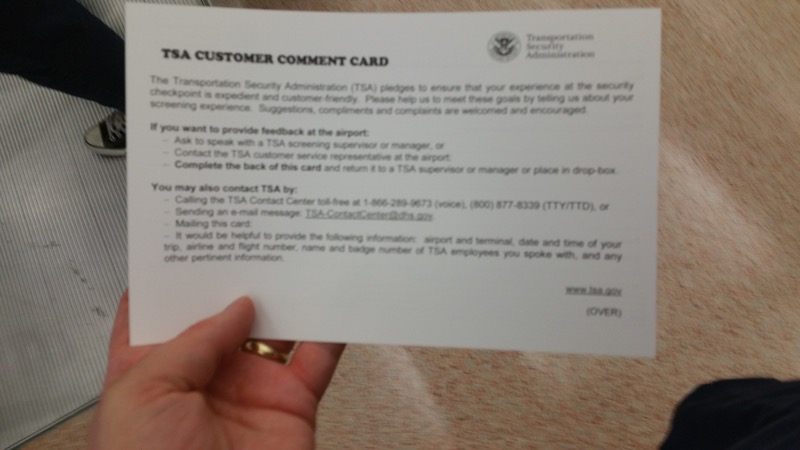
More analogous learning from airports, this time from Dulles — and all their feedback prompts and props right around the security experience. These are all posted around the TSA, for people who have just gone through their pre-flight screening, to get feedback on the experience.