
Categories
How will legal services evolve?

 Justice Innovation

Originally posted on the d.school’s Whiteboard:
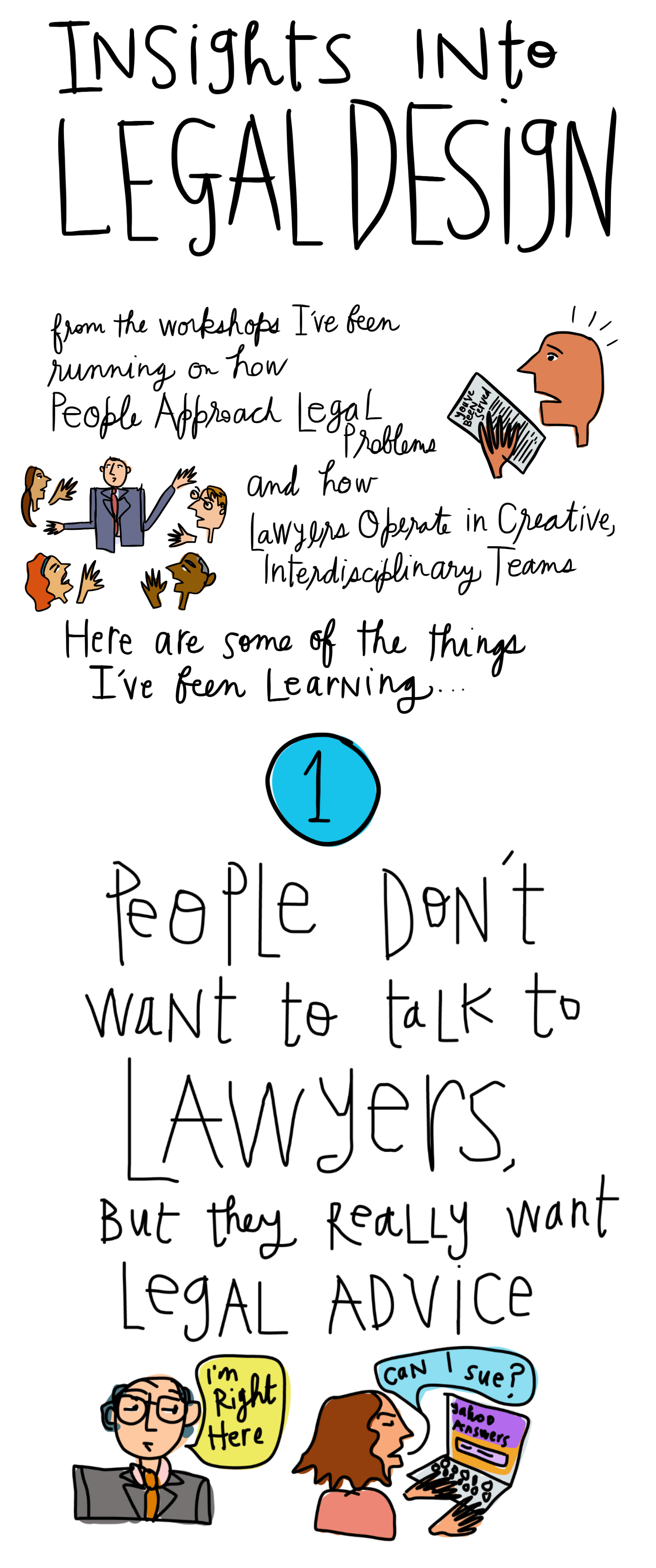
Over this past fellowship year, I’ve run so many workshops and pop-up classes on how to make law more engaging and usable for “normal people”.
People with legal problems or who aren’t highly educated are not alone in this “normal” bucket. People with PhDs, highly paid professionals, even law school graduates fall into this category as well — they want and need legal tools and processes that are built for “normal people”. That’s not to say these people want everything dumbed down. But they don’t want to use an exhausting amount of brain power to just figure out how to get from A to B in the world of law.
No one — except some supernormal lawyers — really enjoys the status quo of densely textual legalese and byzantine process that you must go through to get a legal problem solved.
So now, in the post-workshop phase of my fellowship, I’m sifting through all the findings and putting together patterns that can guide new families of legal product and service design.


One branch of Legal Design Ideas I’m working on is using crowdsourced information to improve transparency of how legal regulations are implemented & processes are carried out.
An idea in this branch is a Parking Ticket Map — that could use a crowdsourced map like Ushahidi, or other reporting platforms. Individual users can report when & exactly where they’ve received parking tickets or traffic tickets.
Ideally, the resulting map would be populated with advice on each parking space in a region — telling potential parkers what common problems with the parking space are. Peer advice can help ensure that the parker would be able to comply with all of the laws that apply to her when she’s parking. The map can also be a public resource, showing trends in enforcement & making it clear how government authorities are behaving.
The crowdsourced map could be integrated into other services, like Google Maps, or parking availability apps, that have already mapped parking spaces with some exactness. the information about
This originates out of problems we’ve heard in user research, in which the parking signage does not communicate all the rules that actually apply to a parking space. There are some common problems that people make mistakes with, and that cost hundreds of dollars.
This might be about the special rules that apply to a parking space — like when it is sufficiently on a slant that the parker must have their wheels turned toward the curb. Or it might be when there is a danger in that space — like where registration stickers are commonly stolen & then the parker will be ticketed for out-of-date stickers.
This could also be useful in tracking trends, biases, and overpolicing.

Pangea Legal Services is a San Francisco collective of lawyers who are working to support immigrants with legal support — through a low-bono and pro-bono model that provides services on a sliding scale of fees.

It works on asylum cases, deportations, DACA and U-visa applications, among other services. It also does policy work on behalf of immigrants.
Pangea’s ultimate goal is to be larger non-profit that provides legal services for fees that fit potential clients’ budgets — to bring greater access to legal support to immigrants.
Its self-description:
Vision
We envision a world where the fundamental right to move is respected and appreciated by all. Our view is that all human beings are entitled to respect, documents, and a process through which to move, settle and resettle in the world.
Mission
The mission of Pangea Legal Services is to stand with immigrant communities and to provide services through direct legal representation, especially in the area of deportation defense. In addition to direct legal services, we are committed to advocating on behalf of our community through policy advocacy, education, and legal empowerment efforts.
Organizationally, we aim to create a non-profit that is scalable through a sliding scale fee structure and can grow in immigrant communities around the United States.

Immigrant Justice Corps is a fellowship program (or legal incubator) to train people to serve as legal assistants for immigrants in the US. Its application is currently open for a new round of fellows — with applications due in just over a week. Both JDs and non-JDs can apply to serve immigrants through the Corps

It offers two kinds of fellowships, Justice Fellows and Community Fellows. Justice fellows are placed with legal service groups and work with their host to represent complex cases. Community fellows are placed in organizations in community groups and conduct outreach & represent community members on more basic cases.
It accepts 15 Community Fellows annually, from a pool of non-JDs, including people with just a college degree. It offers an unset number of Justice Fellows to recent law graduates and law clerks. This year there are 25 Justice Fellows.
Its self-description:
The Immigrant Justice Corps (IJC) is the country’s first fellowship program dedicated to meeting the need for high-quality legal assistance for immigrants seeking citizenship and fighting deportation.
Inspired by Chief Judge Robert Katzmann of the U.S. Court of Appeals for the Second Circuit, the IJC brings together the country’s most talented advocates, connects them to New York City’s best legal and community institutions, leverages the latest technologies, and fosters a culture of creative thinking that will produce new strategies to reduce the justice gap for immigrant families, ensuring that immigration status is no longer a barrier to social and economic opportunity.
Extension of the Community Fellowship application deadline:
The IJC is pleased to announce that the deadline for submitting applications for the Community Fellowship has been extended to May 15. Apply today!

A group out of Chicago, the Mikva Juvenile Justice Council, is making an app to help young people understand & go through an Expungement legal process. The Knight Foundation is funding the project through its Prototype fund. The project aims “To create a prototype version of Expunge.io, a mobile app designed to aid juvenile offenders in navigating the legal process.”

via JJC Recommends App for Expungement.
Mikva’s Juvenile Justice Council met with the Cook County Board President, Toni Preckwinkle, to present their recommendation on creating an app for juveniles to get more information on the expungement process. The group has been working all through the summer to address the question of “what tools, policies, and practices do youth need to successfully transition from corrections to community?”
Through online research, site visits and talks with pioneers in the field, Mikva youth found that out of 25,000 arrests made in 2012, there were only 70 requests for expungement (expungement refers to the process of sealing prior convictions or arrests). Given this information, and the dearth of accessible information about the process, the Council suggested creating an Expungement App. This tool will serve to educate young detainees and parents about the process and help them find appropriate lawyers and classes.
The group is very excited about this project. “This will help make the expungement process more convenient for teens; teens can easily start the process from their phones,” they said.

Last week I attended the presentation about Modest Means Incubators at the State Bar of California. There were judges, private lawyers, law school admins, legal service providers, and court staff there to talk about how new models of legal practices can be built.
The goal is to provide new access to lawyers to those with low & modest incomes — and also to train new JDs with practical skills that can help them start their own practices.
Here are my quickly sketched notes from the session:


Two years ago, there started some talk about US courts using SMS and other phone-based communication to issue reminders for court hearings to people. It seems several other countries have already launched such pilots.

The Qatari government’s Supreme Judiciary Council has one such program live, at Court Hearing SMS Reminder – Hukoomi – Qatar E-government. Any litigant can register online & in three steps, the Court will let them “receive text message reminders on selected court hearing dates and times.”
The steps the citizen needs to follow:
Qatar’s SMS reminder service is free and apparently beyond just a pilot stage.

Australia also has an SMS Reminder system, in Pilot phase. The Magistrates’ Court of Victoria runs the pilot in the Criminal Diversion Program. There is no way to register for the system online — like Qatar allows. The Australian Court provides these details on its pilot:
In order to increase compliance with Criminal Diversion Plans, an SMS Reminder Pilot has been established statewide and administered from the Melbourne Magistrates’ Court. Offenders who have not finalised their Criminal Diversion Plans within a month or a week of their stated completion date, will receive reminders via SMS to do so.
The aim of the pilot is to increase compliance of offenders, reduce paper usage by the court, and in doing so, reduce the cost of administering the Criminal Diversion Program. The SMS Reminder Pilot commenced on Monday 2 July 2012 and has so far indicated a strong early result with respect to the aims of the pilot.
For more information, please contact your local Criminal Diversion Coordinator, available at all headquarter Magistrates’ Courts within Victoria.
Another court in Australia, the Adelaide Magistrates Court, also is issuing phone-based reminders to offenders and accused in criminal proceedings. Tessa Akerman in The Advertiser wrote an interview with one of the judges involved.
ACCUSED criminals can expect text messages reminding them to appear in court, as the state’s magistrates courts embrace the use of technology.
Judge Elizabeth Bolton, the state’s Chief Magistrate, told The Advertiser that people needed to realise the world had changed and we needed to “make the most of, within our resources, using those technological solutions”.
“We’ve still got some things in the pipeline from the process redesign project we did a year or two ago. I’m hopeful we will get around to the SMS project that might help people who, as many do, forget or don’t read their papers correctly, whatever it is, just as a reminder as you do from your hairdresser, your dentist,” she said.
But it would have to wait “a little bit” because computer resources were needed to complete the fines transition process, due to start in February.
Judge Bolton said shrinking budgets and changing needs were behind the court’s increasing take-up of technology.
“I think it’s incumbent on all of us to realise we are living in an age where there is much more technological facility than previously and if people habitually put all their stuff in their mobile phone rather than … write it on a piece of paper or have a calendar … then we just have to realise that’s how their minds operate.”


